
How Short-Term Disability Insurance Can Help You During Childbirth, Pregnancy, and Maternity Leave
What Expecting Parents Need to Know About Income Protection During Pregnancy, Childbirth, and Maternity. Understand How Short-Term Disability Insurance Works and Available Insurance Options.

Are you looking for short-term disability insurance to cover childbirth or maternity leave? If so, you've come to the right place.
We have helped many women secure short-term disability coverage for childbirth and maternity, and we can help you, too.
The benefit of this type of insurance is that you have your own "paid maternity leave" when you give birth.
In this article, we discuss the qualifications for coverage, where to get it, what it actually covers, underwriting, and more.
Understanding how this coverage actually works and what eligibility entails is the difference between having financial breathing room and scrambling through unpaid leave with a newborn.
What is Short-Term Disability Insurance?
Short-term disability insurance is a type of policy that pays you a monetary benefit if you are sick or hurt and can't work. Let's say you tear a tendon in your arm and need surgery. Your doctor tells you that you can't work for 2 months. That is a disability, and your short-term disability policy pays you a benefit that you use to pay your bills while you recover.
Benefits last for the duration of your contracted benefit period or until you are cleared to return to work, whichever comes first.
Short-term disability insurance plans typically have benefit periods of 3 months or 6 months. It pays for disabilities of a short period of time. Longer benefit periods, such as 2 years or more, are characteristic of long-term disability insurance.
Disability insurance is the only type of policy that pays you a benefit if you are ill or hurt and a doctor indicates you can't work. One thing to note: it replaces a portion of your salary, not 100% of it. Typically, plans replace 60% of your salary or income.
Most employer-sponsored short-term disability plans cover childbirth and pay you a benefit during your maternity leave.
What Needs to Be Done First
I know life gets busy. When it comes to pregnancy and childbirth, there is one important step that couples tend to forget. I know what it is because I receive phone calls or emails about it all the time. And no, it's not about picking out a name or when/where they should have the baby shower. Important, but not nearly on the same level.
The important step that some couples miss is having a plan BEFORE pregnancy. You see, many insurance plans, including employer-sponsored ones, have probationary periods (more on that later). If you are pregnant during this time, then the carrier could deny your childbirth claim. Additionally, many couples assume they have coverage through work, only to find out they don't. Moreover, they may know they have employer-sponsored insurance, but it doesn't cover childbirth/maternity. Sometimes, at this point, it's too late.
You'll read this theme throughout this article. So, if it is all possible, before getting pregnant, you'll want to:
- contact your HR department and learn about the company's maternity leave plan
- if you live in a state with PFML, contact your HR department or contact the state department that manages the fund
- review short-term disability insurance options that cover a normal childbirth
- review other options that may be available
I go over all these options, but first I discuss employer-sponsored short-term disability insurance.
Short-Term Disability Insurance for Childbirth and Maternity Eligibility
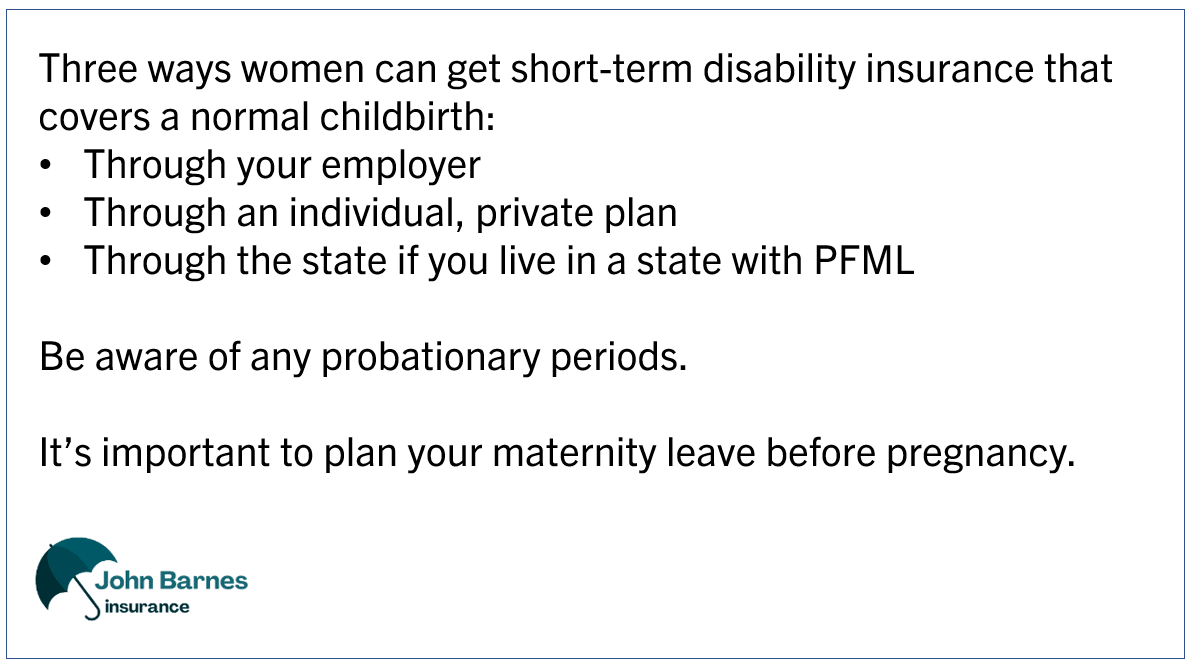
Women typically have three ways to obtain short-term disability insurance:
- their employer,
- an individual plan, or
- their resident state if it offers a short-term plan (more on this later).
However, not every short-term plan covers a normal childbirth as a disability. Most plans through an employer do cover childbirth as a disability. However, only a couple of private, individual short-term disability insurance plans cover childbirth as a covered disability. Regardless of what you have, you will want to make sure your plan covers a normal childbirth. This is an area many people overlook until it is too late; they assume their short-term disability insurance policy covers a normal childbirth, but in fact it does not.
Here's another thing: short-term disability plans aren't designed for the pregnancy itself. You see, pregnancy itself isn't a disability. The confusion starts because pregnancy is a known condition, not an unexpected disability. You are expected to work unless you experience pregnancy complications (more on that later).
The Probationary Period in Most Short-Term Disability Plans
That's where many women get this messed up: to be eligible for normal childbirth coverage (assuming your short-term plan covers a normal childbirth), you need to meet a waiting period, also called a probationary period. This probationary period is the "blackout period" before submitting a claim for childbirth. Essentially, this means you can't be pregnant at the time of application.
Individual short-term plans typically contain a 9- or 10-month requirement. Employer-sponsored short-term plans may cover this length or a shorter period, such as 30 or 90 days. (Review your employer plan or reach out to your HR department for details.) States that offer PFML also have a 3- to 6-month probationary period, depending on the plan.
If you file a claim for childbirth during this probationary period, the disability insurance company will deny your claim. So, if you are currently pregnant, you must review your policy's eligibility parameters.
Typical Structure of Short-Term Disability Benefits for Childbirth From Employer Plans
Please note that every plan differs in how it pays out benefits for childbirth, particularly for employer-sponsored plans. You will want to thoroughly review the material from your employer and/or contact your HR department.
Short-term disability insurance for childbirth replaces a portion of your income during the weeks you're unable to work due to delivery and postpartum recovery.
Here's what makes it different from standard maternity leave. Maternity leave is time off. Short-term disability is income replacement during this time. The policy doesn't care if you're bonding with your baby or healing from a complicated birth. It only cares about one thing: that you face a temporary disability as certified by a doctor. (Disabled, in this case, includes bonding time.)
This is how the coverage structure typically works for employer-sponsored plans:
- Benefit period: Usually 6 weeks for vaginal delivery, 8 weeks for cesarean section
- Payout percentage: Between 50% and 70% of your salary or income
- Waiting period/Elimination period: Often 7 or 14 days before you are eligible for benefits
- Be under the care of a doctor
The waiting period typically starts on delivery day. The plan doesn't pay you any benefits during the waiting period. Most companies require you to use sick days, sick time, or PTO/vacation time during this timeframe. Additionally, depending on the plan, the benefit period may start on the day of delivery or on the day after the waiting period ends. You will need to consult with your employer's plan to learn the specifics.
Finally, the benefit you receive isn't your full salary. It's a percentage, around 60% of your salary.
Structure of Short-Term Disability Insurance on Individual Policies for Childbirth
Not every employer offers short-term disability insurance. Additionally, many people don't live in a state that offers PFML.
Thankfully, those people still have individual options. However, one key difference between employer-sponsored plans and individual plans is underwriting. Employer-sponsored short-term disability plans generally provide guaranteed coverage, but disability insurance companies offering short-term policies generally do not. That means you may not qualify if you have a serious medical condition.
Individual short-term disability insurance isn't as plentiful as employer-sponsored plans. Nevertheless, we work with a couple of carriers that do offer short-term disability plans that cover a normal childbirth.
Here are some general parameters of individual short-term disability plans.
Parameters of Private, Individual Short-Term Disability Plans
Individual short-term disability insurance plans differ greatly from employer-sponsored plans. For one, individual plans will have probationary periods, usually 9 or 10 months. So, as we discussed before, you can't be pregnant at the time of application.
Unlike employer-sponsored plans, individual short-term disability plans underwrite. Usually, the application is simple, with basic questions about medical conditions. That means, yes, underwriters can decline your application if you have a moderate or serious medical condition. Carriers review your medical history for the 12 months before your policy's effective date. If a doctor diagnosed you with a medical condition during that period, the carrier considers it a pre-existing condition. If you later file a disability claim related to that condition, the insurance company will deny the claim. Pre-existing conditions include pregnancy, which is why you can't be pregnant at the time of application.
| Insurance Type | Elimination Period | Benefit Amount | Underwriting |
|---|---|---|---|
| Employer Sponsored | 1-2 weeks | 60% of salary usually | Usually no |
| Individual Plan | your choice | 60% of salary usually | Yes |
| PFML | varies by state | 60% of salary usually | None |
Waiting periods / elimination periods include:
0/7 days
7/7 days
0/14 days
14/14 days
30 days
90 days
The first number represents the waiting period for an accident, while the second number represents the waiting period for an illness. Honestly, if you want a 30- or 90-day waiting period, you might be better off with a long-term disability insurance policy.
Carriers usually offer a benefit based on 60% of your salary, with some having a cap. You can select a 3-month, 6-month, or even up to a 1- or 2-year benefit period. This is another key distinction between an employer-sponsored plan and an individual plan. An employer plan already sets the terms of the contract; you can't change or modify it to suit your needs. Conversely, you select the parameters of an individual policy.
What does this mean to you? Well, let's say you have a 3-month benefit period - adequate for most maternity leave situations. However, you need additional time due to documented medical reasons. While your company may extend your leave with documented reasons, an individual plan won't. It will pay up to the benefit period and nothing beyond that. If you don't have long-term disability coverage (which I recommend), benefits stop.
Carriers that cover childbirth consider it as an illness. Again, you have to meet the probationary period first. Then, after the waiting period ends, you will be eligible for benefits.
Short-Term Disability Insurance Through State PFML
Currently, 14 states and Washington, D.C. offer or have enacted mandatory paid family medical leave (PFML). These states include:
California
Colorado
Connecticut
Delaware
Maine
Massachusetts
Minnesota
New Jersey
New York
Oregon
Rhode Island
Virginia
Washington State
D.C.
These programs offer paid family leave and parental leave as well as short-term disability coverage for illnesses and injuries. Many of these programs include additional coverage such as paid military exigency leave. Additionally, they include childbirth coverage (in many cases up to 12 weeks), with some states offering paternity leave (i.e., father leave).
Most states fund these programs via payroll taxes. I can't review each state, so if you live in one of these states, I encourage you to reach out to your HR department and/or consult your state's program via their website.
How Short-Term Disability Insurance Policies Address Complications of Pregnancy
So far, we have discussed a normal childbirth with no pregnancy complications. However, complications do arise. If complications arise, like postpartum hemorrhage, gestational diabetes, bed rest, infection, severe morning sickness, or emergency surgery, you may qualify for extended benefits beyond the standard recovery window. But you'll need updated medical documentation that proves continued disability, not just a longer bonding period.
This is where the short-term disability policy actually provides for a disability. In these situations, parameters of your plan may change. For instance, with individual policies, most carriers waive the 9- or 10-month probationary period. Additionally, both employer-sponsored plans and State PFML plans may extend benefits beyond the parental leave period.
Individual Short-Term Disability Insurance Options That Cover a Normal Childbirth
We work with a couple of carriers that cover a normal childbirth as a benefit. Remember, these carriers will cover any type of short-term disability that prevents you from working.
Plan #1
- elimination period/waiting periods of 0/7, 7/7, 14, 30, 60, or 90
- benefit periods of 13 weeks, 26 weeks, 1 year, or 2 years
- benefit amount: up to $1,500 per week for an employee and $1,000 per week for a self-employed professional
- offers a lump sum $500 (max) benefit for childbirth
Plan #2
- elimination period/waiting periods of 0/7, 7/7, 14, 30, 60, or 90
- benefit periods of 3 months (13 weeks), 6 months, 1 year, or 2 years
- benefit amount up to $3,000 per month, based on salary
- typically, the benefit period ends when your doctor gives you the OK to go back to work, when your employer requires you back, or when the contracted benefit period ends, whichever comes first
Contact us if you would like to learn more.
Other Insurance Options for Expectant Mothers That Cover a Normal Childbirth
Other insurance options exist that will cover a normal childbirth. These options include hospital indemnity plans, which help cover hospital expenses. Hospital indemnity plans pay a fixed dollar benefit, which usually includes a hospital admission benefit, daily inpatient benefit, a surgical benefit, and more. For example, a plan might pay $3,000 upon a hospital admission and $200 per day for each day in the hospital. A handful of carriers cover hospital birth. Here is an example.
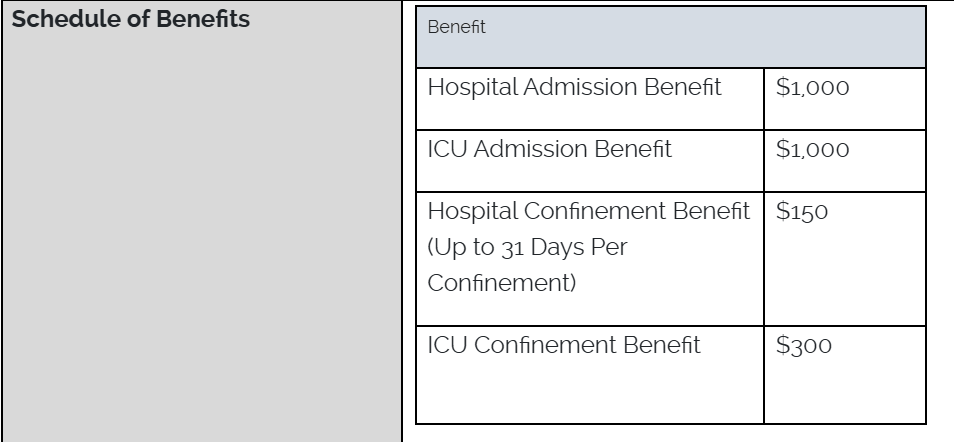
The advantage of hospital benefit plans is that you can use the money for whatever you want. That is what "indemnity" means. If the covered event happens, you receive the corresponding monetary benefit. While the intention is to use the money to pay your hospital bills as a result of your childbirth, you can use the money as a "paid maternity leave."
We work with a couple of plans that pay $1,000 or $5,000 toward "paid maternity leave". Be aware, however, that, as with individual short-term insurance plans, you can't be pregnant at the time of application.
Contact us if you have any questions. As you can see, we have plenty of options that can help you during your maternity leave.
What About the FMLA? Does the FMLA Cover Childbirth?
Yes, the FMLA covers childbirth and maternity leave; however, the Act does not pay you for your time away from work. The FMLA, or Family and Medical Leave Act, allows covered employees to take unpaid leave to address covered family and medical reasons. One of these reasons is to care for a newborn child. One of the FMLA's most important benefits is that it provides job-protected leave. The law prohibits employers from terminating employees who take leave to care for a newborn child or for any other qualifying FMLA reason.
It's important to note that the FMLA applies to employers with more than 50 employees, among other eligibility requirements. It is federal law and followed in every state. States that implement their own PFML plans also contain job-protection provisions. Additionally, states that offer PFML cover additional employers not covered by the FMLA.
Additional Insights About Short-Term Disability Insurance for Childbirth, Pregnancy, and Maternity Leave
I've worked with many women in securing additional coverage for their maternity leave. The information below is a compilation of these conversations that I have had with couples. Hopefully, they answer questions that you hadn't thought of yet!
What Most People Get Wrong About Pregnancy and Short-Term Disability Insurance
his is where the confusion hits hardest: carriers do not consider pregnancy itself as a disability. Many women tend to think that once they are pregnant, they can claim disability or take a leave. That isn't the case.
Essentially, the nine months you're pregnant don't automatically qualify you for short-term disability benefits, unless, of course, you have pregnancy-related complications. You’re still expected to work during a healthy pregnancy. The disability portion kicks in only when pregnancy or childbirth physically prevents you from performing your job.
Here's what that distinction eliminates:
You can't file a claim in your second trimester because you're tired or uncomfortable. You can't collect benefits for morning sickness unless it's so severe that your doctor medically restricts your work (a condition called hyperemesis gravidarum, which is rare but does happen and requires documentation). And you can't use short-term disability to extend your time off just because you want more weeks with your baby.
The other major misconception is timing. Many women assume they can buy short-term disability insurance after they find out they're pregnant. Most short-term disability insurance policies classify pregnancy as a pre-existing condition if you're already pregnant when you apply. Essentially, the carrier declines your application and/or claim in this case.
If you're planning to get pregnant in the next year or two, the smartest move is to analyze your available insurance and maternity leave options, develop a plan, and secure coverage before conception.
The Waiting Period That Catches Everyone Off Guard
Many women forget about the waiting period. Understanding the waiting period, also known as the elimination period, can save a lot of headaches, especially if you have an employer-sponsored group plan. The waiting period is the number of days between the start of your disability and the date your first benefit check arrives.
Standard elimination periods on short-term disability policies range from 7 to 14 days. Some employer-sponsored plans waive this period specifically for childbirth, but many don't. If your policy has a 14-day waiting period and you deliver on a Monday, you won't be eligible for benefits until 2 weeks later.
Why this matters more than it sounds:
Those first two weeks after the baby is born are when your expenses spike—diapers, formula if you're supplementing, pediatrician visits, prescriptions for recovery, etc. You're also not earning your regular paycheck. If your household budget depends on two incomes, that gap can sting.
You will want to make sure you save money in preparation for this time period, and definitely pre-purchase items that you can.
Additionally, many employer-sponsored plans require you to take PTO or vacation time during the elimination period. As I mentioned before, you must understand how your company's maternity leave policy works before you are pregnant.
When does the elimination period start?
If you have an individual plan, the elimination period typically doesn't count toward your total benefit period. For example, if you have a 14-day waiting period and a 3-month benefit period, your waiting period starts first, followed by the benefit period.
However, this structure diverges under employer-sponsored plans. Many employer plans follow a similar structure. For example, if your policy covers 6 weeks of disability and has a 2-week waiting period, you're looking at 8 weeks total from delivery until benefits end, not 6. As I mentioned above, plan your unpaid leave around this timeline to avoid running out of money before your doctor clears you to return to work.
Conversely, some company maternity policies require the elimination period and the benefit period to run concurrently. Using our example above, if your policy covers six weeks of disability, and you have a 14-day waiting period, then you receive benefits for only 4 weeks, not 6. Let's say your company approves an 8-week maternity leave. Well, you will receive payments for only 4 weeks in this scenario.
Do you now see my advice about planning well before you are pregnant?
What Happens When Pregnancy Complications Change Your Recovery or Maternity Leave Timeline
If you develop post-birth complications like preeclampsia, placental abruption, or severe postpartum depression, you can request an extension of your maternity leave. This is done more easily through an employer-sponsored plan. Your doctor can confirm your complications and recommend extending your maternity leave through a disability certification. You then present this to your employer for approval.
That means additional weeks of benefits, but only if your policy allows it and your condition meets the insurer's definition of continued disability. Complications post-birth change things. Your maternity leave goes from a bonding/maternity leave to a true disability claim. So, carriers are going to analyze your inability to do your job due to your childbirth complications.
Common complications that extend coverage:
- C-section delivery: Automatically adds 2 weeks to the standard 6-week benefit period
- NICU admission for baby: Some employer plans extend benefits if the mother is medically required to remain near the hospital
- Postpartum hemorrhage or infection: Covered if it physically prevents you from working. Your doctor must provide supporting medical documentation.
- Severe perineal tearing or surgical complications: May qualify for extended recovery time depending on medical necessity.
Here's the part most people miss: your doctor has to certify that you remain disabled. You can't just decide you're not ready to go back. The insurer will request updated medical records, sometimes multiple times, to verify ongoing disability. If your medical documentation shows you're medically cleared but you don't feel ready, your insurance provider will stop your benefits. Carriers treat emotional readiness and medical disability as separate issues.
If you're dealing with postpartum depression or anxiety severe enough to impact your ability to work, that can qualify as a disability, but it requires a formal diagnosis and treatment plan documented by a licensed mental health provider. Insurers scrutinize mental health claims more heavily, so expect requests for therapy notes, medication lists, and treatment timelines.
If you have an individual short-term disability insurance plan that covers a normal childbirth, this process is a bit different. Let's say you develop a post-birth complication. You go to the doctor, and she confirms you have a disability that will prevent you from working. You present this information to your employer and the insurance carrier. If you have any time left in your benefit period, then the carrier will likely pay up to the maximum benefit period. What if you don't, or what happens at the end of the benefit period? Well, that's why it's important to have long-term disability insurance. This is a situation where long-term disability policies would continue your benefits. And... what if you don't have long-term disability coverage? You'll have to speak to your employer and find out what options you have. Do you want to do that? Probably not.
Frequently Asked Questions About Short-Term Disability Insurance, Maternity Leave, and Childbirth
We answer frequently asked questions about short-term disability insurance and childbirth.
Does short-term disability cover pregnancy or just childbirth?
Yes, most employer-sponsored plans and some individual, private short-term disability insurance cover childbirth and postpartum recovery; however, not pregnancy itself. Pregnancy is considered a normal condition, not a disability. Benefits begin when you're medically unable to work due to delivery, typically starting on your delivery date. Standard coverage through your employer typically lasts 6 weeks for vaginal delivery and 8 weeks for a cesarean section. You cannot file a claim during pregnancy unless you have pregnancy complications like morning sickness or preeclampsia that medically prevent you from working, which requires physician documentation.
Does short-term disability insurance cover maternity leave
It does not cover maternity leave on its own. Short-term disability insurance plans typically include the birth of a child as a disability, which is why you receive 6 or 8 weeks of pay, or longer if you are on a PFML plan or an individual plan.
Can I buy short-term disability insurance after I'm already pregnant?
Most individual, private short-term disability policies classify pregnancy as a pre-existing condition if you're already pregnant when you apply. This means the carrier will likely decline your childbirth claim or decline your application altogether.
The best time to secure coverage is before conception. If you're already pregnant, check if your employer offers group coverage during open enrollment, as these plans sometimes have less restrictive pre-existing condition clauses.
How much does short-term disability pay for maternity leave?
Short-term disability insurance for childbirth typically pays 60% of your salary. The exact percentage depends on your policy terms. Additionally, most policies include a 7- to 14-day waiting period before your first payment arrives, though some employers waive it for childbirth. Providers usually pay benefits weekly or biweekly throughout your certified disability period. If your policy pays 60% of your salary and you earn $4,000 per month, you'd receive approximately $2,400 per month during your recovery period.
What's the difference between FMLA and short-term disability for childbirth?
FMLA (Family and Medical Leave Act) protects your job for up to 12 weeks of unpaid leave, while short-term disability provides income replacement during your medically certified recovery period. FMLA guarantees you can return to your position or an equivalent role; it does not provide pay. Short-term disability pays you a percentage of your salary but doesn't protect your job. These benefits run concurrently, not consecutively. If you take 6 weeks of paid short-term disability, you still have 6 weeks of unpaid FMLA-protected leave remaining. You need to qualify separately for each: FMLA requires 1,250 hours worked in the past year at a company with 50+ employees. At the same time, short-term disability depends on your policy's specific eligibility requirements.
Does a C-section qualify for more disability pay than vaginal delivery?
Yes, cesarean section delivery typically qualifies for 8 weeks of short-term disability benefits compared to 6 weeks for vaginal delivery. This is because a C-section is major abdominal surgery requiring a longer medically necessary recovery period. The extended coverage is usually automatic once your physician certifies the delivery method on your claim paperwork. You don't need to request additional time; the policy terms vary by delivery type. If complications arise from either delivery method, your doctor can certify extended disability beyond the standard timeframe, but you'll need updated medical documentation proving continued inability to work.
Please note that if you have a private, individual plan, then the process will be different. Your carrier will pay you up to the maximum benefit period you selected during the application. If you exhaust your benefit period and need extra care due to a cesarean section delivery or post-birth complications, then you will need to contact your HR department and/or file a claim for long-term disability.
What documents do I need to file a short-term disability claim for childbirth?
You generally need three primary documents to file a short-term disability claim for childbirth: an Attending Physician Statement completed by your OB-GYN certifying your delivery date, delivery type, and expected recovery period; employer verification from HR confirming your employment status, earnings, and last day worked; and your personal statement describing your job duties and confirming you're unable to perform them due to childbirth. Start your claim 30 days before your due date to avoid processing delays. Submit the physician statement at your final prenatal appointment and follow up within one week, as incomplete or delayed physician paperwork is the most common reason claims remain in pending status for weeks after delivery.
Final Thoughts About Short-Term Disability Insurance and Childbirth
Short-term disability insurance for childbirth is income replacement during the weeks you're medically unable to work due to delivery and recovery.
In this guide, we discussed employer-sponsored options, reviewed states that offer PFML plans, and private individual short-term disability insurance plans that cover a normal childbirth. We also discussed what happens to your disability insurance if pregnancy-related or post-birth complications occur.
Are you ready to learn more, have questions, or find out what you qualify for? Contact us or use the form below.
I am happy to go over your options and answer any questions you have. Remember, there is no risk in contacting me. I only work in your best interest, not mine or an insurance carrier's. If I can't help you, I will point you in the right direction as best I can, and we will part as friends. You can always reach back out to me if your needs change.