5 Maternity Leave Insurance Options and How They Work
Wondering how maternity leave works and what benefits you may qualify for? This guide explains five maternity leave options, including disability insurance and paid leave programs, to help you maximize your income and benefits during pregnancy and postpartum.

Let me guess: you are self-employed, or you don't have access to paid maternity leave, so you are looking for maternity leave insurance? Am I right?
If so, you've come to the right place. I have helped many women obtain individual maternity leave insurance.
However, just the words "maternity leave insurance" confuse almost everyone. Part of the problem is that no product is actually sold under that name. You hear words like "elimination period," "FMLA," and "TDI." HR tells you one thing, and a friend tells you another. Online forums contradict each other. What's the truth?
You can stop guessing. In the US, "maternity leave insurance" usually comes from five sources: your employer, federal job protection, state programs, private disability insurance, and/or hospital indemnity insurance. Once you know which of these you have, the rest falls into place.
Although I will focus on the two types of insurance I can directly help with (disability insurance and hospital indemnity insurance), I'll also cover employer coverage, state-funded plans, and federal protection through the FMLA. Knowing all your options helps you make informed decisions.
Key Takeaways About Maternity Leave Insurance
- Short-term disability insurance is the closest thing to maternity leave insurance, and it usually replaces part of your pay for 6 to 8 weeks after birth. However, this timeframe differs by carrier and your company policy.
- You generally need to buy individual coverage before you get pregnant, because insurers treat pregnancy as a pre-existing condition.
- FMLA protects your job for up to 12 weeks but pays nothing. It is job protection, not paycheck protection.
- Thirteen states run active paid family leave programs that can add paid bonding time.
- Combine your employer benefits, state programs, individual plans, and savings to cover the full leave.
Five Ways to Establish Your Own Maternity Leave Insurance
There is no such thing as "maternity leave insurance" as a specific product. Maternity leave is comprised of 5 options. Combining these helps a mother establish your own maternity leave insurance so you can care for your new baby.
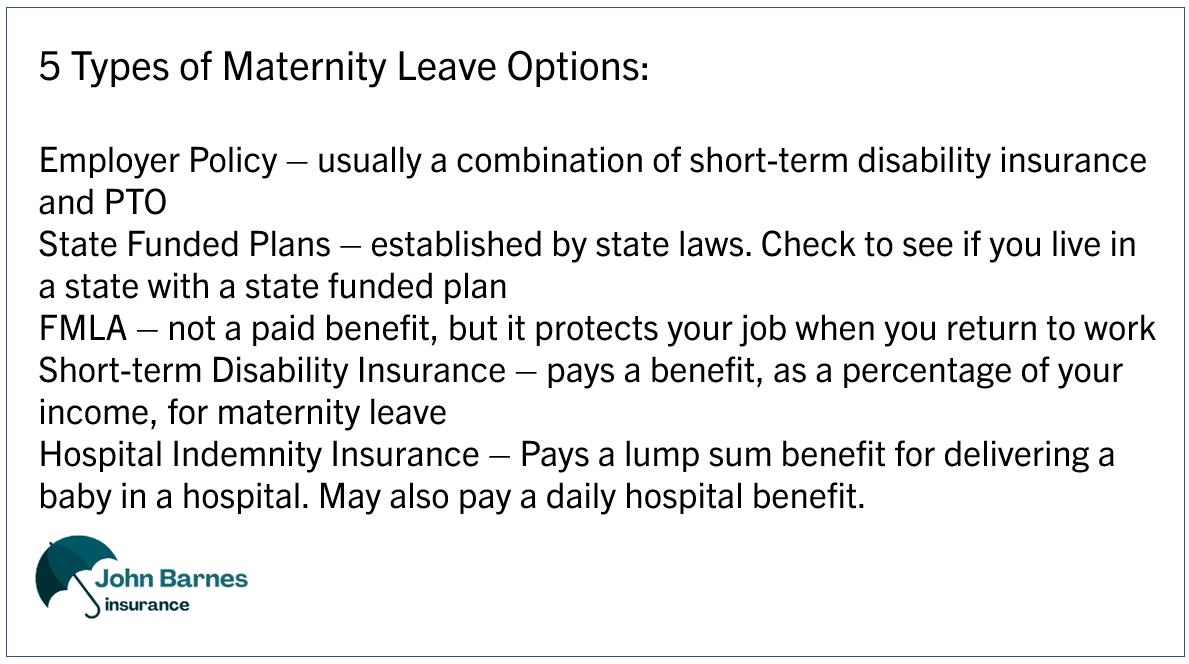
- through your employer plan
- through a state-funded plan
- the Family and Medical Leave Act (FMLA)
- a private, short-term disability insurance policy
- a private, hospital indemnity plan
Although the Family and Medical Leave Act is unpaid leave, it's an important part of your maternity leave. The other options all offer paid family leave benefits.
Employer Options for Maternity Leave
If you are an employee, you likely have a maternity leave plan through your employer. This plan usually consists of a combination of using:
- your paid time off (PTO) and
- short-term disability insurance established through your employer
Speak with your human resources department about the company policy, preferably before you become pregnant. Some employer plans require you to use any PTO first, followed by the disability insurance benefits.
Most employer plans have a maternity leave time limit, such as 8 weeks or 10 weeks. Employers in states with a state-funded disability plan may have different maternity leave time limits.
If you work for an employer that doesn't offer paid maternity leave, please refer to our private, individual options below (short-term disability insurance and hospital indemnity insurance).
State Maternity Leave Laws
Where you live can matter more than where you work. Some states run their own insurance programs, funded through payroll taxes, and those programs pay you while you're on leave. States have various names for these plans, such as "PFML" (for Paid Family and Medical Leave).
States with active paid family and medical leave programs
As of September 2026, thirteen states (including DC) have active programs: California, Colorado, Connecticut, Delaware, DC, Maine, Massachusetts, Minnesota, New Jersey, New York, Oregon, Rhode Island, and Washington, with Maryland and Virginia enacting mandatory programs but not scheduled to start paying benefits until 2028.
States with mandatory temporary disability insurance (TDI)
Only five states provide temporary or short-term disability benefits: New York, California, Rhode Island, Hawaii, and New Jersey. In these states, state disability pays you during medical recovery after birth. After that, you can move to paid family leave for bonding time (Hawaii has no paid family leave program).
States with voluntary options
Another eight states allow private insurers to offer paid family leave insurance, but the state isn't involved in contracting with insurers. Ask your employer whether it has bought one of these plans.
These plans differ in structure and coverage; however, they all provide paid maternity leave. Some states require all employers to contribute, while others exclude small businesses. For example, a state may exclude companies with fewer than 5 employees from the state plan.
If you live in one of these states, ask your office manager whether your company contributes. If so, they must follow state law on maternity leave benefits. You can also look on your paycheck. If you see a term such as "PFML" or something similar in the deductions section, you have paid maternity coverage through the state plan.
If your state has no program, your leave depends on FMLA, your employer, and any private short-term disability coverage or hospital indemnity policy you hold.
The Family and Medical Leave Act (FMLA)
The Family and Medical Leave Act (FMLA) protects your job. It does not replace your income. According to the Department of Labor, FMLA gives certain employees up to 12 weeks of unpaid, job-protected leave per year and requires employers to maintain group health benefits during the leave.
Even though it's not paid family leave, it protects your job when you return to work.
However, not everyone qualifies for FMLA. You qualify if you:
- Work for a covered employer, which includes all public agencies, all public and private elementary and secondary schools, and companies with 50 or more employees
- Have worked for that employer at least 12 months
- Logged at least 1,250 hours in the past 12 months
- Work at a location where the company employs 50 or more employees within 75 miles
The advantage of FMLA:
- Your same job or a nearly identical one when you return, since the DOL says employees must be restored to the same or virtually identical position
- Continued health insurance on the same terms
- The option to run it alongside paid benefits, because FMLA leave may be unpaid or used at the same time as employer-provided paid leave
One detail catches many parents off guard. Under DOL rules, vacation, sick leave, or PTO time does not count toward the 1,250 hours; only hours actually worked count.
Paid vs Unpaid Maternity Leave
Paid and unpaid leave usually overlap. Your FMLA clock runs while short-term disability benefits or state benefits pay you. Here is where each piece comes from.
| Maternity Option | Paid or Unpaid? |
|---|---|
| FMLA | Unpaid, but job protection |
| Short-term disability insurance | Paid, a percentage of your salary |
| State paid family leave | Paid, a percentage of your salary. Refer to your state law. |
| Employer parental leave | Paid, refer to company policy |
| PTO and sick days | Paid at your full rate |
| Personal leave of absence | Usually unpaid |
Fully paid parental leave is still uncommon. A Congressional Research Service report found that 27% of private-industry employees had access to paid family leave through their employers in March 2023. That gap is why most families combine several sources.
Short-Term Disability Insurance as a Maternity Leave
Short-term disability (STD) insurance pays you part of your income when a medical condition keeps you from working for a limited time. When people say "maternity leave insurance," they mean this type of policy.
If an illness or injury temporarily prevents you from working, short-term disability insurance replaces part of your earnings. Most plans pay out weekly and replace a set share of your earnings. Pregnancy and postpartum recuperation are considered illnesses under a short-term disability plan.
| STD Characteristic | Description |
|---|---|
| Benefit Percentage | The share of your pay you receive. Plans typically pay 40 to 70% of base pay |
| Elimination Period | The unpaid waiting period before eligible for benefits |
| Benefit Period | The maximum number of weeks the plan pays |
| Group Plan | Coverage offered through your employer |
| Individual Plan | Coverage offered directly through an employer |
You can get short-term disability insurance through your employer (if they have established a disability insurance plan) or through individual disability insurance companies. Check with your HR department to see if your company offers short-term disability insurance. If not, you could purchase a private plan (more on that later).
Does Short-Term Disability Insurance Cover Pregnancy/Maternity?
Yes, most short-term policies do; however, it depends on your plan. Most short-term disability plans established through an employer include pregnancy and childbirth recovery as a covered disability. Additionally, I work with a couple of individual short-term plans that cover a normal childbirth as a maternity leave benefit.
Coverage applies to:
- Recovery after a vaginal or cesarean delivery
- Doctor-ordered bed rest before birth
- Pregnancy complications such as preeclampsia or placenta previa
- Postpartum complications that delay your return
STD does not pay for time you spend bonding with your baby once your doctor says you have recovered. That bonding time comes from paid family leave, PTO, or unpaid leave. As I mentioned before, if you are an employee, you will need to consult your employer's maternity leave policy or state laws if you live in a state that offers a state-funded PML plan.
However, the situation changes if you are self-employed or have no access to paid maternity leave. In that case, we work with a couple of private short-term disability insurance plans that cover a normal childbirth.
How Short-Term Disability Works During Pregnancy and Maternity Leave
Short-term disability insurance treats childbirth as a medical event with a clear start and end. Here is how a typical claim plays out.
Before birth: If you keep working until labor, your claim starts on your delivery date. If your doctor certifies that you cannot work earlier due to pregnancy complications, benefits may start before your expected due date.
The waiting period: Your plan's elimination period runs first. Many plans set this at about 7 to 14 days. Some plans let you use PTO during this time.
The payout phase: Once the waiting period ends, you receive your benefit. How much you get depends on your plan.
The end point: Benefits stop when your doctor clears you to work or when your plan's maximum runs out, whichever happens first.
How Long Coverage Lasts
The length of your benefits depends on how you deliver and whether complications arise. Most plans follow the standard recovery periods doctors use.
Recovery-based benefits run shorter than the policy's overall limit. Short-term disability usually pays benefits for three to six months, although some policies extend payments for up to a year. For a routine birth, though, insurers rarely pay beyond the 6- or 8-week standard unless your doctor documents a medical reason. Private, short-term disability insurance plans may pay out longer.
When to Get Coverage
Timing matters more than anything else with maternity leave insurance. Buying too late while pregnant, or enrolling in your employer's short-term plan too late, and your pregnancy is probably excluded from coverage.
⏰ Buy an individual policy before you conceive, ideally 12 months or more before you plan to try. Enroll in your employer's short-term plan (if offered) as soon as possible.
Most insurance companies classify pregnancy as a pre-existing condition and disallow coverage for up to twelve months post-purchase. Additionally, many carriers, even those that offer plans through employers, have a waiting period for childbirth claims. For example, plan documents might state that you can file a childbirth claim after a 10-month waiting period.
🏢 Enroll in your employer's group plan during open enrollment or when you're hired, because group plans often have looser pre-existing condition rules.
📅 Watch for "late entrant" rules if you enroll in a group plan outside your first eligibility window, since those rules can trigger medical questions or exclusions.
🔍 Read the policy's pregnancy clause before you sign, because some individual policies exclude normal childbirth entirely. This is common in long-term disability insurance.
If you are already pregnant and have no coverage, look for any group plans your employer offers. Then check your state's programs, which generally don't use pre-existing condition exclusions.
How to Apply/Get Short-Term Disability Insurance and Steps for a Childbirth Claim
Getting short-term disability insurance involves two separate tasks. First, you get a policy; later, you file a claim. If you are an employee, follow these steps in order.
- Check your current benefits. Log in to your HR portal and find your short-term disability plan. Note the benefit percentage, waiting period, and maximum weeks.
- Enroll or buy. Sign up for the group plan at open enrollment, or apply for an individual policy before you conceive.
- Tell HR early. Share your expected due date around the second trimester so HR can start the leave paperwork.
- Request the claim forms. Your employer or insurer will send an employee statement, an employer statement, and a doctor's certification.
- Have your doctor complete the medical section. The doctor confirms your due date, delivery type, and any work restrictions.
- File close to your due date. Many insurers let you open a claim before birth and then confirm it after delivery.
- Send proof of delivery. Submit the delivery date and type so the insurer can set your benefit length.
- Track your benefits. Keep copies of every form and note every phone call.
If your claim is denied, ask for the denial in writing. Most plans give you a formal appeal window.
If you are self-employed or have no access to paid maternity leave, follow these steps:
- Contact a reputable insurance broker. He or she can search for and review plans available in your state.
- Apply.
Carriers will require answers to a health questionnaire. As long as you don't have serious medical conditions, carriers should approve your application.
- Note the Effective Date/Start Date. This date is important. This is your policy start date and what carriers use to determine when you can file a childbirth claim. For example, if your policy starts on January 1 and has a 10-month waiting period for childbirth, you can file the earliest childbirth claim on October 1. Carriers will deny any childbirth claim before this unless the claim corresponds to pregnancy complications.
- Request Claim Forms. Notify the carrier about a month before your due date.
- Complete the Claim Forms. You and your doctor will have information to fill out and return.
- Provide Proof of Delivery. The carrier will need proof of delivery, usually a hospital bill or discharge papers.
- Benefits begin after your waiting period. Your benefits will last for your benefit period or until your doctor clears you to return to work, whichever comes first.
Long-Term Disability
Long-term disability insurance (LTD) rarely pays for a normal birth. The timing rarely lines up. LTD policies commonly have an elimination period, often 90 days, before benefits begin. Most people recover from childbirth well before that.
Because of its extended waiting period, standard pregnancy and recuperation are usually excluded from LTD coverage. However, long-term disability insurance can still help in serious situations.
Long-term disability insurance may pay if you face:
* Severe complications that keep you off work for months
* Postpartum cardiomyopathy or other lasting heart conditions
* Severe postpartum depression that meets your policy's definition of disability
* Injuries from delivery that need surgery and a long recovery
Think of LTD as a backup for worst-case scenarios. If you have both STD and LTD, a long claim often moves from one to the other once STD benefits run out.
Hospital Indemnity Insurance
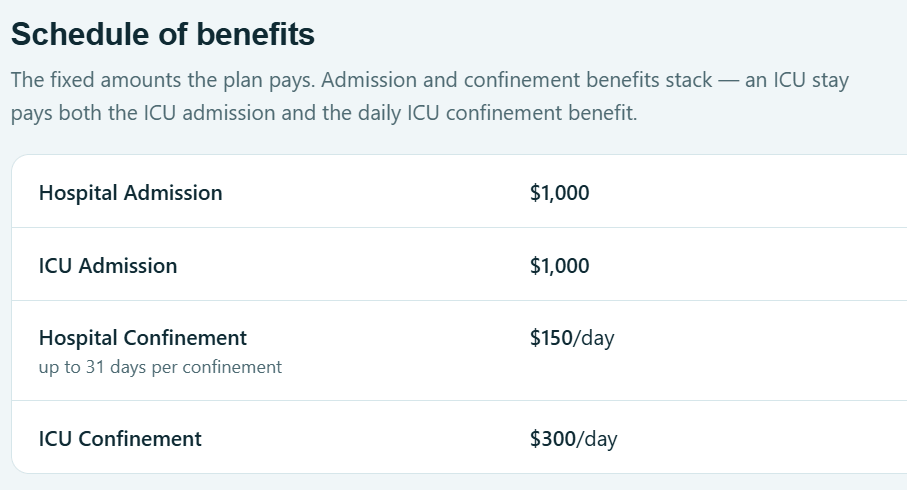
Some hospital indemnity insurance plans will pay cash benefits upon the birth of a new child. What is a hospital indemnity insurance plan? It is a type of supplemental health insurance plan that pays a fixed cash benefit upon a covered hospital event. For example, a hospital indemnity plan might pay $1,500 for an outpatient surgery.
The main purpose of hospital indemnity insurance is to help defray medical bill costs not covered by your underlying health insurance. Some plans, but not all, provide a fixed, monetary benefit for a childbirth in a hospital. These plans usually pay a lump sum benefit for a hospital admission and a daily hospital benefit. For example, a plan might pay $5,000 for a hospital admission benefit and $150 per day for a daily hospital benefit.
A main advantage of hospital indemnity insurance is that it does not coordinate with your health insurance. This means you can use the money however you want to. You can use it to:
- pay out-of-pocket medical expenses
- unexpected expenses
- living expenses, like a "paid maternity leave"
Many carriers that offer hospital indemnity insurance use a simple health questionnaire and a 12-month pre-existing look-back period. This means any diagnosed health condition, including pregnancy, is considered a pre-existing condition for the 12 months after the policy start date. As long as you don't have serious medical conditions, you should qualify just fine for hospital indemnity insurance. Hospital indemnity insurance can be easier to qualify for compared to short-term disability insurance.
Hospital indemnity insurance benefits do not coordinate with other types of insurance. You can combine short-term disability insurance and hospital indemnity insurance for a stronger paid maternity insurance plan. Here is an example hospital indemnity insurance plan:
Other Ways to Financially Prepare For Maternity Leave
You now know the 5 maternity leave options. They are:
- through your company policy (a combination of short-term disability insurance and PTO)
- through state-funded disability/maternity plans
- FMLA - unpaid, but protects your job when you return to work
- private, individual short-term disability insurance
- private, individual hospital indemnity insurance
However, these options rarely pay 100% of your pre-maternity leave earnings. Here are some options to help close the gap.
💰 Build a leave fund that covers the difference between your take-home pay and your benefit checks for every week you plan to be out.
🗓️ Save up PTO and sick days in the year before your due date to cover the unpaid elimination period on your disability insurance.
🧾 Do a trial run by living on your expected benefit amount for two or three months before birth.
💰 Add a hospital indemnity insurance plan. It doesn’t coordinate with any insurance. The fixed cash benefits likely cover the income gap. The carrier pays the benefits to you. You can use them any way you want.
🏥 Add your baby to your health plan within the 30-day special enrollment window after birth.
💳 Pause extra debt payments during leave and switch to minimums so you keep more cash on hand.
👶 Use a dependent care FSA if your employer offers one, so you can pay for childcare after you go back to work with pre-tax dollars.
📞 Ask HR whether your company offers paid parental leave on top of STD, since some employers add bonding weeks.
Frequently Asked Questions About Maternity Leave Insurance
I answer questions about maternity leave insurance. If you have a specific question, please reach out and contact me.
Does maternity leave insurance cover my full salary while I’m out of work?
Usually, no. Maternity leave insurance doesn't cover 100% of your salary or income. If you want to achieve that, you may have to combine different types of insurance, save for/establish a "maternity leave fund", or bank PTO and sick days through your employer.
How much does private maternity leave insurance cost?
The cost depends on the product type, age, and health. Employer-sponsored disability insurance or state-funded plans usually cost less because your employer helps pay the premiums. Private, individual short-term disability insurance and hospital indemnity insurance generally cost more because you pay the entire premium.
Can I purchase private maternity leave insurance?
Yes. You can purchase an individual short-term disability insurance plan and/or a hospital indemnity insurance plan. Plans are not available in every state. Contact us to find out what is available in your state.
Which insurance plans offer short-term disability coverage for maternity leave?
Nearly all employer-sponsored short-term disability insurance covers childbirth as a maternity leave. However, check with your company and the policy. Only a few individual disability insurance carriers cover childbirth as maternity leave.
Are there insurance providers that cover pregnancy complications before delivery?
Yes, insurance companies cover pregnancy complications. You have to be under the care of a doctor who certifies you as disabled. Your benefits would start sooner.
What’s the difference between maternity leave insurance and paid family leave?
Maternity leave insurance is usually short-term disability coverage, which pays for the mother’s own medical recovery from childbirth. It’s typically employer-sponsored or individually purchased and based on medical disability, so it generally covers the physical recovery period.
Paid family leave is a wage-replacement benefit for bonding with a new child, regardless of whether the parent gave birth. It can apply to birth, adoption, or foster placement, and it’s available to fathers and non-birth parents as well. It comes from one of two sources. It can be a state program funded through payroll contributions, or an employer benefit.
Can I get short-term disability insurance if I'm already pregnant?
Usually not through a new individual policy, because insurers treat an existing pregnancy as a pre-existing condition. Group plans through your employer may still cover you, depending on their rules and when you enrolled.
Does short-term disability insurance cover my partner?
No. Short-term disability insurance covers only the person who has the medical condition, so in this case, it pays the birthing parent. Partners can use paid family leave in states that offer it, along with employer parental leave or FMLA.
Paid family leave plans offered through certain states may cover your spouse. Check to see if you live in a state with a paid family leave and what are the plan rules.
Can I use FMLA and short-term disability at the same time?
Yes. They usually run concurrently. FMLA protects your job while STD pays part of your income.
Will short-term disability cover a miscarriage or stillbirth?
Many plans cover recovery from pregnancy loss as a medical disability. Benefit length depends on your doctor's certification and your plan's terms.
Does adoption qualify for short-term disability?
No. Short-term disability insurance pays for medical recovery, so adoptive parents usually rely on paid family leave, employer parental leave, or FMLA.
Is maternity leave insurance worth buying on my own?
Yes! It often pays off if you plan to get pregnant within a year or two, have no group plan, live in a state without paid leave, and/or have no path to paid maternity leave.
Final Thoughts About Maternity Leave Insurance
Maternity leave insurance can look confusing at first. It gets much simpler once you sort it into pieces.
- Short-term disability pays you while your body recovers.
- FMLA keeps your job safe.
- State programs and employer leave can pay you for bonding time.
- Hospital indemnity insurance provides an additional cash benefit while your body recovers.
Check what your employer offers this week. Look up your state's program. If you are planning a pregnancy and have no coverage, purchase a short-term disability insurance policy and/or a hospital indemnity plan before you conceive.
Do you have any questions or ready to learn what is available? Contact us or use the button below. I am happy to answer any questions you have or analyze the options available in your state.