Disability Insurance for Dental Hygienists: Cost, Coverage, Own-Occupation Policies & Best Options
Your hands are your career. So are your back, wrists, and neck. One injury or illness and your income stops, but most dental hygienists skip the one protection that pays you when you can't work.
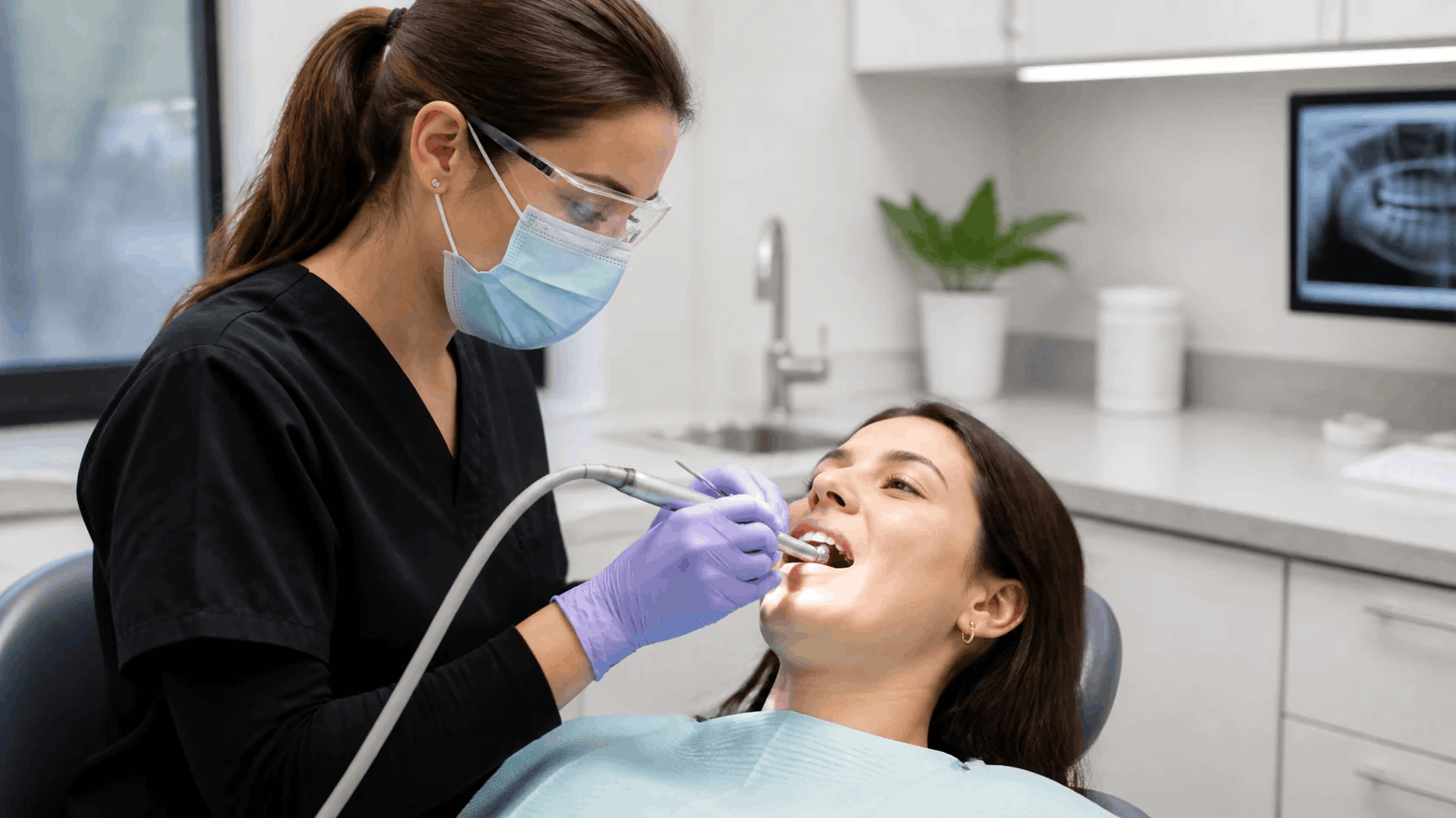
Dental hygienists don't think about disability insurance, but they should.
Your entire paycheck depends on healthy hands, a strong back, a working neck, and pain-free shoulders.
Am I right?
As a dental hygienist, you spend hours hunched over patients, repeating motions that constantly strain your body. Carpal tunnel, rotator cuff injuries, and chronic back pain aren't just possibilities in this profession. They're occupational hazards that force thousands of hygienists out of work every single year.
Ask around. I am sure you will hear stories about dental hygienists who developed some type of disability that derived from the job.
Yet most dental hygienists and dental assistants work without disability insurance. They assume it's too expensive, too complicated, or that their employer should provide it. The reality? Group coverage, even if offered through your practice, usually isn't enough, and waiting until you have symptoms means you'll never qualify for the protection you actually need.
I've helped hundreds of dental hygienists obtain disability insurance. In this guide, I discuss the ins and outs of disability insurance, including costs, underwriting, and pitfalls to avoid when buying coverage.
Key Takeaways for Dental Hygienists and Disability Insurance
Own-occupation definition matters most: The exact contract language determines whether you get paid. Confirm that benefits are based on your inability to perform your duties as a dental hygienist and can continue if you work in another job.
Benefit period to age 65 or 67: Consider this length if the extra cost makes sense. Musculoskeletal conditions common among hygienists tend to be permanent, not temporary, so a short benefit period leaves you exposed.
3 riders make a formidable policy: True own occupation coverage, residual disability benefits (partial disability), and guaranteed insurability options.
Association plans have real limits: ADHA and CDHA group plans can be a useful starting point, but their own-occupation definitions, limited partial benefits, and portability often fall short of individual policies.
Premium range is 1% to 3% of income: For most hygienists, that works out to roughly $140 to $215 per month for solid long-term coverage.
Independent broker comparison saves money and catches weak definitions: No single carrier offers the strongest terms across every feature or is "perfect." Experienced, independent brokers make a difference in finding the right policy.
Why Dental Hygienists Carry a Higher Disability Risk Than Most Workers
Dental hygienists work in a mechanically unforgiving position for hours at a stretch. Scaling, root planing, and instrumentation require sustained fine-motor control, a precision grip, and a forward-flexed posture that continuously loads the cervical spine and lower back. These stressors repeat across every patient and every shift, which is why musculoskeletal conditions rank among the leading causes of career interruption in this profession. The body accumulates damage over years even when no single incident feels serious.
The most commonly reported work-related conditions include
- carpal tunnel syndrome,
- De Quervain's tenosynovitis,
- trigger finger,
- tension-neck syndrome,
- trapezius myalgia, and
- lumbosacral disc injuries.
These aren't rare. I've heard of many dental hygienists having these issues. Research consistently identifies musculoskeletal disorders of the neck, shoulders, lower back, hands, and wrists as the primary affected regions. The cause is almost always cumulative strain from repetitive pinch-grip instrumentation, awkward static postures, and ultrasonic handpiece vibration, not a single traumatic event.
A general office worker with wrist tendinitis can often adapt her workflow. A dental hygienist faces a much harder adjustment. Clinical hygiene demands tactile sensitivity, grip strength, and positional endurance, so even a partial reduction in dexterity or range of motion can make patient care impossible. That's why your disability coverage needs to match your specific occupation, not a generic definition that leaves the door open to a denied claim.
Let's Not Forget Illnesses
I'd be remiss if I didn't mention illnesses as a cause of disability. In fact, illnesses such as cancer and stroke make up most of the disability claims after musculoskeletal disorders.
I speak to dental hygienists all the time who are rightly concerned about income protection from back, neck, shoulder, wrist, arm, and hand issues. However, they should be equally concerned about illnesses.
The disability stats on illnesses such as cancer, multiple sclerosis, diabetes, etc., don't lie. Doctors diagnose these conditions in the healthiest people every day. It doesn't matter if you are a CEO, professional athlete, salesman, mechanic, or dental hygienist. Illnesses don't discriminate, and they don't care about your situation, family, or what is going on.
This fact underscores the importance of disability insurance. However, not just any disability insurance...
Why Dental Hygienists Need Own Occupation Disability Insurance
Most disability policies pay benefits only if you can't work any job. That's a problem for skilled healthcare professionals such as dental hygienists.
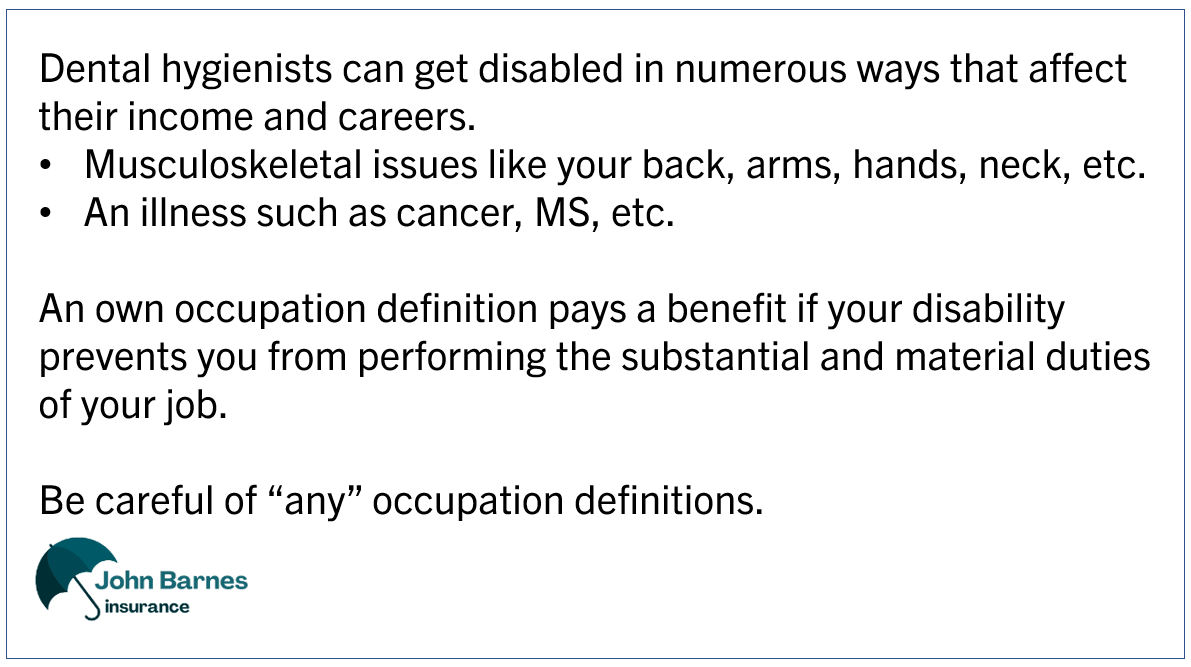
Dental hygienists need a disability insurance policy with the own occupation definition. Own occupation disability insurance pays if you can't perform the specific duties of your own occupation as a dental hygienist, even if you could technically do another job. This distinction matters more than almost anything else in your policy. For example, repetitive strain injuries might make scaling and root planing impossible, but you could still answer phones or file paperwork. In this case, an own-occupation disability insurance policy pays. However, a standard policy with the "any occupation" definition of disability won't pay you a dime.
Own occupation disability insurance protects what you spent years training to do. You didn't go to dental hygiene school to become a receptionist. If your hands can't handle instruments anymore, you need a policy that acknowledges you've lost your career, not just your ability to earn any income doing any job.
Look for policies specifically labeled "own-occupation" or "regular occupation." Look for contract language that states a disability is your inability to perform the material and substantial duties of your occupation. Avoid "any occupation" policies no matter how much cheaper they seem. Plans with this definition pay only if you can't perform the duties of "any" occupation suited to your education, experience, and skill set. They are cheap; however, the savings disappear the moment you file a claim and discover the fine print requires total disability across all employment categories before paying benefits.
Where Dental Hygienists Buy Disability Insurance
Dental hygienists have three main paths to disability income insurance, each with different trade-offs.
Independent insurance agents (like me) who specialize in disability coverage can shop multiple carriers for you and explain policy differences without pushing one company's products. They get paid through commissions from insurers, so you don't pay them for their service.
Professional associations like the American Dental Hygienists' Association offer group disability plans to members. These policies typically require less medical underwriting and cost less than individual policies, but the coverage is often less comprehensive and usually isn't portable if you leave the profession. More on this later.
Group disability insurance through your employer, if available. Some dental practices may offer group disability insurance. One advantage of group disability insurance is the cost; it can be cheap because your employer pays part of it. However, plan limitations, such as disability definitions and benefits, usually offset any cost advantage. An employer plan can be a starting point, but it's not a complete income protection plan.
Most hygienists get the best combination of price and coverage by working with an independent agent (i.e., me) who understands healthcare professional policies. Agents like me know which carriers pay claims without a fight and which ones have a reputation for finding reasons to deny coverage when you need it most.
Types of Disability Insurance Available for Dental Hygienists
Three types of disability insurance exist for dental hygienists. They are:
- short-term disability insurance
- long-term disability insurance
- accident-only disability insurance
We discuss each of these next.
Short-Term Disability Insurance for Dental Hygienists
Short-term disability insurance covers disabilities for a short term. These disabilities might include a broken hand or a short-term illness like the flu. They typically have a short waiting period (e.g., 7 days) and a short benefit period (e.g., 3 months).
One benefit of short-term disability plans is that some disability insurance carriers cover a normal childbirth as a "maternity leave" plan.
Short-term disability plans are designed to be simple and "plain vanilla". They are intended to cover a total disability for a short term. They aren't meant to provide partial disability benefits or other benefits.
If you have saved enough for emergencies or don't need coverage for a normal childbirth, you may not need short-term disability insurance.
Long-Term Disability Insurance for Dental Hygienists
When you think of disability insurance, you likely think of long-term disability insurance. Long-term disability insurance covers disabilities for the long term.
Long-term disability insurance is by far the most important disability coverage you can have. It is the true safety net. The disability stats don't lie: 1 in 4 people under the age of 65 will face a disability. This is from the Social Security Administration. Moreover, most disabilities last longer than a year. Some industry advocacy groups say the average long-term claim is three years. Claims departments I speak to say their average is around 18 months. Does it matter? No. Just know that long-term disabilities exist, some even lasting one's lifetime. This is why you buy long-term disability insurance: to protect your family and everything you worked so hard for.
Accident-Only Disability Insurance
As the name suggests, this type of disability insurance pays only if you become disabled because of an accident. The accident can be on the job or off the job, like a car accident or slipping down the stairs.
Although accident-only disability insurance is cheap, it offers only 1/3 of the full coverage. Here's what I mean: remember I said most disabilities are musculoskeletal disorders like back issues and illnesses like cancer. An accident-only disability insurance policy covers these situations only when an accident causes them. These plans don’t cover disability from an illness.
Because of its limited disability coverage, accident-only disability insurance works if you can't qualify for traditional disability insurance.
How Disability Insurance Companies Underwrite Dental Hygienists
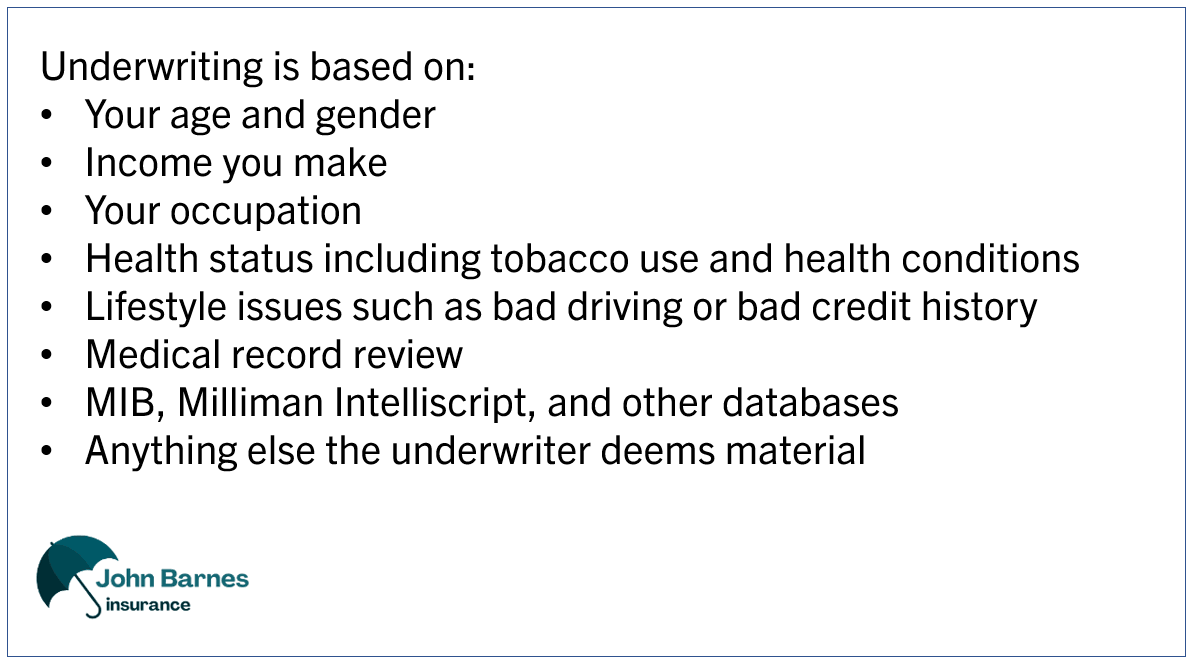
As I noted earlier, companies underwrite based on the following factors:
- your gender
- height and weight
- tobacco and marijuana use
- health conditions
- lifestyle factors such as bad driving, credit issues, etc.
Additionally, underwriters use the following information to analyze your application:
- MIB - Medical Information Bureau report, which contains medical claim data
- Milliman Intelliscript - contains prescription medication history and medical claim data
- Medical records - your medical records, if required
- A paramedical exam - a mini-physical, if required
- A phone interview - usually if the underwriter has a question about a medication, etc. (phone calls are usually quick)
Here's the thing. Disability insurance underwriting is much more stringent than, say, life insurance underwriting. Why? In this case, life insurance is analyzing your probability of dying too soon. Disability insurance underwriters assess your likelihood of becoming disabled, which happens much more often.
Disability Insurance Classifications for Dental Hygienists
Additionally, not all disability insurance carriers see dental hygienists the same way. Each carrier classifies occupations on a disability risk scale from 1 to 5 or 6, with 1 being a high-risk occupation and 5 or 6 being a low-risk occupation. For example, a fisherman would have a disability risk class of 1 (or even an uninsurable occupation), while an office manager might have a disability risk class of 5. The lower the class (i.e., 1), the higher the premiums and the more limited the benefits, all else being equal.
Many top disability insurance carriers in the US classify the dental hygienist occupation as class 1 or 2, noting it is a high-risk occupation. We discussed all the potential disability risks dental hygienists face earlier in the article. However, as an independent insurance broker, I work with many carriers that classify the dental hygienist occupation much higher (i.e., much better).
Better carriers classify the dental hygienist occupation as a 3, 4, or 5. The higher the class, the lower the premium and the better the benefits, all else being equal.
Disability Insurance Cost For Dental Hygienists
Disability insurance premiums vary based on everything we discussed in the underwriting section: age, health, income, and the specific policy features you choose.
Example Cost of Disability Insurance for Dental Hygienists in Their 30s
Here is an example of disability insurance costs. A healthy, female, 30-year-old dental hygienist earning $75,000 annually should expect to pay between $140 and $210 per month for a solid true own-occupation policy that includes:
- a 90-day waiting period
- benefit period to age 67
- partial/residual benefits
- guaranteed insurability rider
That same coverage will cost significantly more if you're 45 or if you want a shorter 30-day or 60-day elimination period.
Conversely, the same coverage costs less if you want a shorter benefit period. For example, a 5-year benefit period will cost between $90 and $120 per month.
Here's what drives your premium up or down:
- Elimination period – The waiting time before you are eligible for disability benefits. You don’t receive any disability insurance benefits during this time. Choosing 90 days instead of 30 days can cut your premium by 30-40%. Make sure you have enough money saved during the waiting period.
- Benefit period – How long benefits continue for one claim. Contrary to what many people think, the benefit period is not the contract length. Your policy lasts until age 65 or 67 (or longer, depending on the carrier), no matter the benefit period. The benefit period is the maximum timeframe you can receive benefits. Disability coverage to age 65 costs more than a 5-year benefit period but provides much better protection. Carriers offer 2-year, 5-year, 10-year, to age 65, and to age 67 benefit periods.
- Benefit amount – Your maximum benefit amount is based on your income. Higher monthly benefits mean higher premiums. Insuring 60% of income costs less than insuring 70%.
- Riders and add-ons – Cost-of-living adjustments, residual disability coverage, catastrophic coverage, and more all increase your base premium but can add valuable protection.
- Your health, income, etc., - everything we discussed in the underwriting section.
Most hygienists find that 1-3% of gross income is a reasonable budget target for disability insurance premiums. It feels like a lot until you calculate what losing your income entirely would actually cost you.
Put another way, disability insurance could cost $0.02 to $0.05 per dollar of income. That is affordable, right? Put simply, disability insurance costs about the same as a cup of coffee.
Individual disability insurance premiums are typically not tax-deductible, but any benefits you receive are tax-free. Group coverage through an employer works the opposite way: you pay pre-tax premiums, but the benefits are taxable. Plans purchased through associations typically follow the same tax structure as individual disability insurance.

Three Critical Disability Insurance Riders that Make a Formidable Policy for Dental Hygienists
It is often overlooked, but you need to answer this question: "What is the main purpose of disability insurance?"
The main purpose of disability insurance is to pay you a disability benefit when you can't work and need money the most.
Keep this answer in mind as I discuss policy riders. Riders add customization and flexibility to your policy.
I want to caution you that riders cost more money. They only make sense if they meet your needs and situation. Otherwise, you're spending money on something you could be saving.
Nevertheless, in my experience, 3 disability insurance riders are extremely important for dental hygienists. These riders support my answer to the question, "What is the main purpose of disability insurance?" They create a formidable policy that pays you regardless of your situation.
True Own Occupation Definition: We talked about this earlier. The true own occupation definition allows you to receive a disability benefit even if you can work in another job. It provides the greatest flexibility. The modified own occupation definition is similar to the "true" definition. It still pays a benefit if you can't perform your substantial duties as a dental hygienist and can't work in another job. You still get paid, though.
Residual or Partial Disability Coverage: An important, often overlooked provision, this rider pays proportional benefits if you can still work but only part-time due to a disability. Disability insurance companies still consider injuries or illnesses that reduce your work to part-time, but only if your contract includes a provision that pays partial disability benefits. For example (easy example), if nerve damage forces you to cut your schedule from five days to three days, residual coverage pays benefits for that 40% income loss.
Future Increase Option, Future Purchase Option, or Guaranteed Insurability Rider: This important rider lets you buy additional coverage later without new medical underwriting. As your income grows throughout your career, you can increase your benefit amount to match, even if you've developed health conditions that would normally disqualify you.
These features add cost to your premium, but they're important components of a strong policy. These 3 riders allow you to:
- get paid if you can't perform the duties of a dental hygienist, but you can work in another field and earn money (true own occupation definition)
- get paid if you are hurt or sick, and can still work, but you are working part-time because of your disability (partial/residual benefits)
- purchase more coverage in the future at guaranteed issue (i.e., no health questions) even if you develop new medical conditions that would normally disqualify coverage
Other Available Disability Insurance Riders
Riders add cost to your policy. Some riders add significant cost! Riders make sense only if they fit your needs and situation. For example, I routinely have my truck driver clients add an accident rider (if available). The accident rider pays an additional benefit if the client gets injured in an accident. This rider may or may not make sense for you as a dental hygienist. See what I mean?
When an agent or broker includes a rider on your illustration, you'll need to ask why the rider is important and analyze the corresponding cost.
Here are a few additional riders available to dental hygienists:
Non-cancelable and guaranteed renewable means the insurance company cannot cancel your coverage, increase your premiums, or change your benefits as long as you pay on time. While this sounds good, this rider can be expensive. Moreover, increasing rates on an in-force policy is something individual disability insurance companies want to avoid.
A cost-of-living adjustment rider increases your monthly benefit by a specified amount after you have been disabled for more than one year. While it helps protect against inflation, it can be expensive.
A student loan rider pays an additional benefit you can use to pay your student loans. This rider may not be worth it for dental hygienists.
A social insurance rider coordinates your benefit with government social programs like the Social Security Administration and your state's workers' compensation plan. This rider reduces your monthly premiums, but it means coordinating your benefit with the government.
Important Guidelines for the Disability Insurance Application
I've completed 1,000 disability insurance applications (no lie), including many for dental hygienists. Here are some guidelines, insights, common mistakes, and pitfalls to avoid when applying for disability insurance.
Be honest with your broker/application. A good quote, and an even better discussion of disability insurance and underwriting expectations, requires honesty with your broker about your health and lifestyle history. I can't tell you how many times I've seen clients apply for disability insurance without fully disclosing health or lifestyle issues, only to have underwriting identify them later. When we address those concerns early, underwriting discussions become much easier, and clients understand what to expect.
Disability insurance is not perfect. No disability insurance plan is perfect. Some cost too much, and others don’t provide enough benefit. Other plans exclude pre-existing conditions. Some have weaker disability definitions and benefits. Every single one has advantages and disadvantages. Many disadvantages depend on your age, occupation, and health. Be comfortable with the downsides, understand them, and remember disability insurance's main purpose. Even a 2-year benefit period, instead of to age 67, provides a serious financial safety net if a breadwinner gets sick or hurt and can't work.
Carriers exclude diagnosed mental conditions from coverage. Disability insurance companies exclude mental conditions such as anxiety and depression from coverage. They consider these conditions as pre-existing. As I mentioned before, if these conditions are stable, will they cause a disability? Maybe, but unlikely.
You don’t need a Cadillac plan. Many professionals want all the bells and whistles on their disability insurance policy. However, this proves very costly. Reframe your thinking about disability insurance. It's meant to provide a benefit when you need the money most. Keeping that mindset lets you buy an affordable policy based on your needs.
Be patient during the underwriting process. Underwriting typically takes four to eight weeks from application to approval.
Apply before having any symptoms. This is a red flag. Maybe you tweaked your back at work or pulled a muscle in your neck. You think it will just get better, but it doesn’t. Now, you think, “Gosh, I need disability insurance!” So you apply, get approved, and then go to the doctor to find out what's going on. The issue is that every carrier has a “quick claims” provision in its policy. If your health issue forces you to file a claim within the first couple of years of the policy, many carriers will do a post-underwriting analysis to make sure nothing was missed during the original underwriting. If they find that you withheld information, then the carrier could deny the claim or rescind your policy.
Pre-existing musculoskeletal conditions often lead to exclusions or riders that limit coverage for those issues. That's why you should apply before you develop the repetitive strain injuries common in dental hygiene work.
How Disability Insurance for Dental Hygienists Compares: Association Group Plans vs. Individual Private Policies
A few dental hygienist associations offer disability insurance to members. The American Dental Hygienists' Association (ADHA) offers disability coverage through its member insurance program, currently administered by AMBA/Mercer Consumer and underwritten by The Hartford. The California Dental Hygienists' Association (CDHA) runs its own self-administered short-term and long-term group disability plan, available to members with an active RDH license and W-2 income, with monthly open enrollment.
On the surface, these association plans sound good, but they have drawbacks. Why? They are based on group disability insurance. Group disability insurance is designed to meet everyone's needs. It is a plain vanilla policy. Group disability insurance is a good starting point, but it shouldn't be your only income protection plan. An individual plan provides much more flexibility and protection.
For example, the true own occupation definition is rather limited on association plans. If you are fine with that, then an association plan may work for you. Here are some major differences between association disability insurance plans and individual disability insurance plans:
| Feature | Association Plan | Individual Plan |
|---|---|---|
| Own occupation definition | Narrower and limited; may include no-work restrictions | True own-occupation definition for the entire benefit period |
| Portability | May lapse if you cancel membership or membership lapses | Yours to keep even if you work in an entirely new career |
| Medical underwrtiting | Generally limited | Full underwriting and health history reviewed |
| Initial cost | Usually lower cost due to group pricing | Higher, but better terms |
| Customization | Limited benefit period and customization | Control over waiting period, benefit period, and customization to your needs |
The main advantages of association plans are accessibility, underwriting, and lower premiums. However, the trade-offs matter more. Group association plans may weaken or terminate if you leave the profession or let your membership lapse, and their own-occupation definitions are often narrower than those in a well-structured individual policy. Additionally, many group association plans do not contain important provisions such as partial or residual benefits. If they do, they usually limit the benefit one way or another. An individual private policy is yours regardless of where you work, which association you belong to, or how your career evolves.
Frequently Asked Questions About Disability Insurance for Dental Hygienists
Here are some answers to frequently asked questions about disability insurance for dental hygienists. If you have additional questions, feel free to check out our answers to everyday disability insurance questions or contact us.
If I leave clinical work or drop my association membership, will my association disability plan continue to cover me?
No, association group plans may lapse if you leave the profession or let your membership or license lapse. The ADHA/CDHA and other associations limit portability, so coverage can weaken or terminate if your membership or license ends. An individual private policy remains yours regardless of where you work or which associations you join. For example, if you switch to a completely unrelated profession, your individual plan still covers you in your new role.
Is adding a cost-of-living (COLA) rider worth the extra premium?
Possibly. The extra premium could be substantial, depending on your age, health, income, and other factors such as your waiting period and benefit period. The COLA rider increases your monthly benefit by a set percentage defined in your contract after you have been on a disability claim for a total disability (not partial disability) for 12 months.
When is the best time in my career to buy disability insurance as a dental hygienist?
Right now. Ideally, you should lock in coverage early, while you are in good health and before any wrist, back, or other health issues appear on your medical record. Applying early often avoids pre-existing condition exclusions, which do happen, and lets you use features like a future increase option as your income rises.
Do association group plans require medical underwriting like individual policies do?
Most association group plans have reduced medical underwriting. ADHA/CDHA group plans may offer limited underwriting, while individual private policies require full underwriting and a review of your health history. That difference can make association plans easier to obtain but may also bring narrower disability definitions, benefits, and exclusions.
What are the top companies offering disability insurance to dental hygienists?
Companies such as Guardian Life, Ameritas, Principal, and The Standard are some of the best disability insurance companies in the US today. However, these companies typically aren't the best option for dental hygienists. Why? Because these companies typically classify the dental hygienist lower, such as a 1 or a 2.
Other carriers exist that classify the dental hygienist occupation higher. As an independent broker, I have access to all carriers, including those that classify the dental hygienist occupation more favorably.
If I have a pre-existing condition, will it be covered?
It depends on the condition. Carriers exclude most pre-existing conditions from coverage. In other words, if you've been treated for a prior condition or have a current, managed condition, you can't claim it. Carriers generally do not cover chronic conditions such as diabetes, sleep apnea, etc.
However, think about it. If you have a chronic condition such as diabetes (let's say) that is managed well, will it cause a disability?
Maybe...maybe not. I would say, if managed well, then unlikely.
It's more important to focus on the countless other reasons one could face a disability. Those other disabilities are the real threat.
One last thing: some carriers will provide a temporary exclusion for recent illnesses or injuries.
What does short-term disability insurance cover for dental hygienists?
Short-term disability insurance usually covers total disabilities of a short duration. Think a broken hand or wrist, a short-term illness like the flu or COVID, an injured back, etc. Some policies also cover a normal childbirth as a maternity leave.
Short-term disability insurance isn't designed to pay partial benefits or offer the flexibility long-term policies do. Short-term disability insurance pays disability benefits for total disability in the short term.
Are disability insurance plans available to part-time dental hygienists?
Yes, part-time dental hygienists can purchase both short-term and long-term disability insurance. Generally, most disability insurance companies consider full-time work to be 30 or more hours per week on average, with part-time hours between 20 and 29 hours per week. However, not many carriers offer disability insurance to part-time professionals. Consult an experienced insurance broker to discuss your options.
Carriers that offer disability insurance to part-time professionals usually scale back the benefits and riders. However, definitions and benefits are typically still strong.
Do policies cover mental health for dental hygienists?
Yes, disability insurance covers mental health issues if they become a disability, provided you don't have a current mental health diagnosis. It's important to note that if dental hygienists already have a diagnosed mental condition, that condition is a pre-existing condition and likely excluded from coverage.
Do dental hygienists need short-term disability insurance?
It depends. If dental hygienists don't have enough saved to live off of during the waiting period on a long-term policy, then buying a short-term disability policy makes sense. Hygienists can always cancel this policy once they have enough saved to cover any waiting period. If they already have enough saved, then they probably don't need a short-term policy. Some short-term policies cover a normal childbirth, which can be advantageous as a "maternity leave" benefit.
What are the ideal disability insurance coverage features for dental hygienists?
Three important coverage features that dental hygienists want to make sure are in their disability insurance policy include:
- true own occupation definition (if not available, then the modified own occupation definition)
- residual disability / partial disability benefits
- guaranteed insurability option / future purchase option
These 3 options create a strong policy that pays hygienists for total, partial, or residual disability and lets them increase coverage regardless of their health status.
A benefit period of to age 65 would be ideal; however, this coverage can be pricey. A 5-year benefit period works well and fits most budgets.
Other riders may be advantageous if they fit into the hygienist's needs, wants, and budget. Other riders include:
- student loan payment rider
- catastrophic disability rider
- cost-of-living rider
- mental / substance abuse rider
- Social / coordination of benefits rider
These can be pricey and only make sense to purchase if they fit your needs and wants.
Final Thoughts About Disability Insurance for Dental Hygienists
The best time to lock in disability insurance was when you started your career. The second-best time is right now, before your body starts showing wear patterns that could exclude coverage or price you out entirely.
I reviewed many aspects of disability insurance for dental hygienists including underwriting, costs, and options.
Do you have any questions about disability insurance, type, cost, or pre-existing conditions?
Are you ready to protect your livelihood with a plan that fits your needs?
Contact us or use the button below.
We have helped many dental hygienists find the right disability insurance policy that meets their needs and budget. I am sure I can help you find an economical plan that protects your income, family, and everything you worked so hard for.