
What is Own Occupation Disability Insurance and Why Is It Worth Every Penny
Not all disability policies are equal and the gap between them can cost you everything. Own occupation disability insurance is the one type that pays your full benefit even if you take another job. Here is what own occupation coverage does that others simply cannot.

Most people spend more time picking a Netflix subscription than they do choosing a disability insurance policy, and that casual approach can turn one misstep into a financial catastrophe. The truth is that not all disability policies work the same way, and the difference between a weak policy and a great one can mean tens of thousands of dollars when you actually need to file a claim. Own occupation disability insurance is the gold standard for income protection. If you have never heard of it or understood what makes it different, this guide will change how you think about protecting your livelihood.
Key Takeaways
- Own occupation disability insurance pays benefits when an individual cannot perform the material duties of their specific occupation, even if they are capable of working in a different occupation.
- The true or pure own occupation definition is the most flexible disability coverage option, allowing policyholders to receive full benefits while simultaneously earning income from a different occupation.
- Group disability insurance policies typically provide modified own occupation coverage for only 2 to 3 years before reverting to the more restrictive any occupation definition.
- Specialized professionals and high-income earners need own occupation disability insurance. The modified own-occupation definition, and even the any-occupation definition, are more suitable for other professionals with general skills.
- Own occupation disability insurance costs more, but that cost comes with important career flexibility.
By the end of this, you will know exactly what own occupation disability coverage is, who needs it most, and what to look for so you never get blindsided by fine print when it matters most.
What Is Own Occupation Disability Insurance?
Own occupation disability insurance pays your full disability benefit if you become unable to perform the specific duties of your current occupation, even if you are still capable of doing other kinds of work.
Every carrier has a slightly different definition of own occupation. Here are some variations of the own occupation disability definition that you will see:
- keeps you from doing all the substantial and material duties of your own occupation, even if the insured can work in a different occupation
- allows you to receive total monthly benefits if you are unable to work in your occupation and are currently working in a different occupation
- total disability benefits are paid if you can't perform the substantial and material duties of your regular occupation
- full benefits are paid if you are unable to work in your own occupation, even if you choose to work in a new occupation
Re-read these again. These mean that if you are sick or injured, the insurance carrier's claims department reviews your case to determine whether you can't perform the "material and substantial duties of your occupation." They also review information from your doctor. If you can't perform your job, you can work in a different occupation (if your situation allows it) and receive both your disability insurance benefits and the income from your new occupation.
Talk about flexibility! Wow!
These own-occupation definitions are a fundamentally different standard from the one used by most employer-group or basic disability insurance policies. Own-occupation coverage means that a surgeon who loses her fine motor skills needed to operate can collect full disability benefits while working as a medical professor or consultant. The policy does not care that she can still earn income somewhere. It cares whether she can "perform the substantial and material duties of her own occupation."
See how that works?
What Are The Definitions of Disability? Own-Occupation vs. Any Occupation
Two main definitions of disability exist in disability insurance policies. The own occupation definition and the any occupation definition of disability.
As I discussed, the own occupation definition means you qualify for benefits if you cannot perform the material duties of your occupation. You can work in another job and receive both your disability benefits and the earnings from your new job. It offers the most flexible definition of disability. It is also known as the "own-occ" definition in insurance lingo.
Conversely, the any occupation definition means you only qualify for benefits if you cannot work in any occupation for which you are reasonably suited by education, training, or experience. It is the most stringent. Some people call it the "any-occ" definition.
In other words, if you have a policy with an any occupation definition, a claims department may deny your disability claim and say that you aren't disabled enough and can work in another occupation. For example, let's say our surgeon above has a policy with the any occupation definition. The claims department might deny her claim and tell her she has the education, training, and experience to work as a professor.
The any occupation is by far the weakest definition. You only collect benefits if you literally cannot work in any capacity that matches your broader educational and experience background. Insurance companies can deny claims under this standard because they can use almost any form of part-time work as evidence against you.
The own occupation definition is the most favorable available. This definition provides the strongest level of protection. It evaluates your disability based on the specific, material duties of your work, not on what a claims adjuster believes you could theoretically do instead. If you sign up for anything less without realizing it, you could find yourself in a brutal situation where you are too disabled to do your actual job but not disabled enough, by the policy's terms, to collect a dime.
This is why own occupation disability insurance is worth every penny. Most people assume all disability insurance policies work the same. They do not, and that assumption is exactly where people get stung when it comes time to file a claim or when the claims department reviews their case.
Why the Definition of Disability Is the Most Important Clause in Your Policy
The definition of disability is the engine of your entire policy. It is the heartbeat and the most important feature in your policy. It determines when you get paid, how much you get paid, and under what circumstances the insurance company can deny or reduce your claim. Most people glance at the monthly benefit and the premium and sign on the dotted line without ever reading this part, which is a serious mistake. It goes back to my introduction: most people spend more time deciding which movie to watch than 20 minutes on what their disability insurance policy will do.
It is something most people never think to check: the clause that defines what it means to be disabled.
Three Definitions Available in Own Occupation Disability Policies
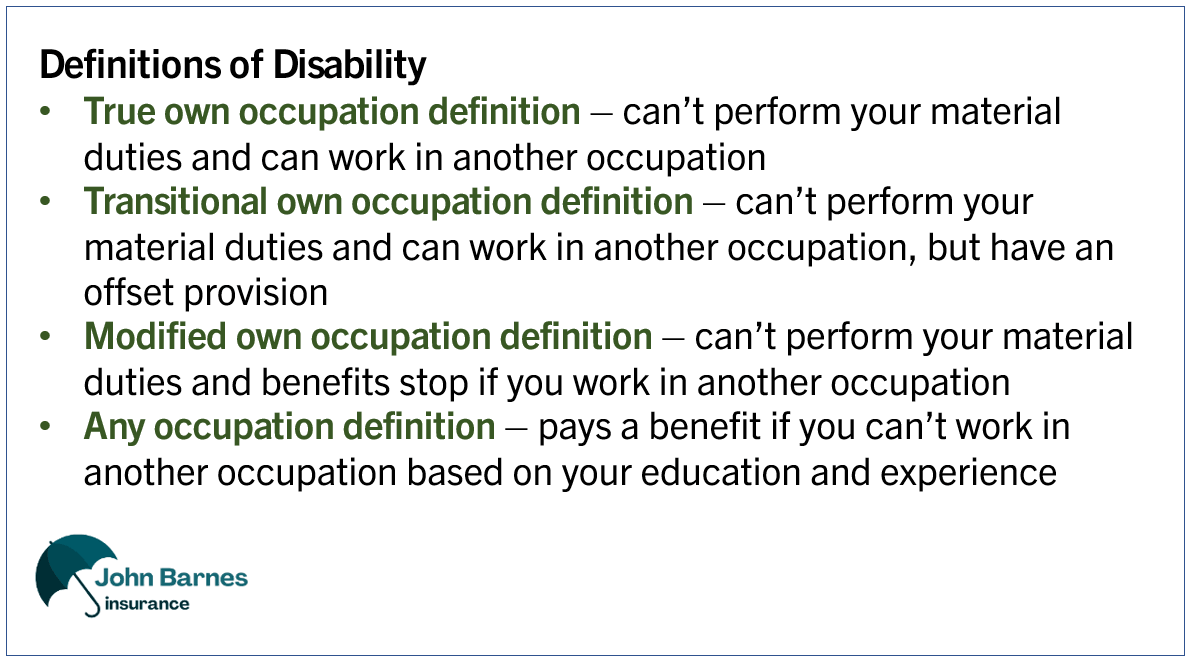
Three definitions, or subcategories, of own occupation policies exist. They include:
- True own occupation: The purest form. You are considered disabled if you cannot perform your specific occupational job duties. You can work in a different field and still collect your full disability benefit. This is the definition we have discussed in the article so far. Some carriers call it "true own-occ". This is the definition that physicians, dentists, attorneys, other high-earning professionals, skilled tradespeople, and those with unique skill sets and training (e.g., dental hygienists, cosmetologists, tattoo artists) actively seek out.
- Modified own occupation: A middle-ground version. You qualify based on your own occupation definition, but if you choose to work in another job while collecting benefits, the carrier will stop your disability benefits. Not as clean, but still stronger than any occupation.
- Transitional own occupation: This is an own occupation definition, but it functions as an offset. It allows you to work in another occupation. Still, your earnings from your new occupation + your disability benefits can't exceed your pre-disability earnings from your previous occupation (that is, the occupation the insurance company bases its claim on).
Example of the Transitional Own Occupation Definition
Here is an example of the transitional own occupation definition. Let's say our surgeon earned $50,000 each month before her disability. Her disability insurance policy pays her $30,000 per month, and she can work in another occupation.
She teaches. If she earns (for example):
- $15,000 per month from teaching, the carrier pays another $5,000 ($50,000 - $30,000 = $20,000 gap - $15,000 from teaching = $5,000 carrier pays)
- $25,000 per month from teaching: the carrier reduces their benefit by $5,000 ($50,000 - $30,000 = $20,000 initial gap, but she earns $25,000 from teaching, so the carrier pays $25,000 instead of $30,000 ($25,000 teaching + $25,000 disability benefit = $50,000)
- $60,000 per month teaching; the carrier pays nothing because she exceeds her pre-disability earnings of $50,000
Reading the policy's definition of disability before purchasing is not optional. It is the single most important research step you can take. Two policies can have the same premium and the same monthly benefit and still perform completely differently when a claim is filed, simply because of their definitions. A breakdown of the definitions of disability below:
| Feature | True Own Occupation | Transitional Own Occupation | Modified Own Occupation | Any Occupation |
| Disability Definition | Can't perform material duties and can work elsewhere | Can't perform material duties + can work, but offset exists | Can't perform material duties & not working elsewhere | Can't work in any job based on your education and experience |
| Working in Another Occupation | Keep disability benefits | Keep disability benefits but offset exists | Disability benefits stop if you work | No disability benefits if you can work in another field |
| Suitable for | Specialized professionals and high earners | Specialized professionals and high earners who don't mind an offset | Office workers/standard professionals | Lower risk occupational roles |
| Cost | Highest | Less than True Own Occ | Moderate | Lowest |
Medical Specialty Occupation Definition for Those Working in the Medical Field
A handful of disability insurance carriers offer the medical specialty own occupation definition. It says something like this: "If you have limited your own occupation to the material and substantial duties of a single medical specialty or dental specialty, we will consider that as your own occupation.” Carriers offer this definition to match the intense skill, training, and demands of specific medical fields. They offer this definition to dentists, surgeons, and other select medical professionals.
Here's Why Own Occupation Disability Insurance is Worth Every Penny
I speak to many professionals about disability insurance. Everyone focuses on the higher premium of own occupation coverage, but almost nobody calculates the actual cost-per-dollar-of-protection ratio.
Yes, cost / $ of protection.
When you run the numbers properly, own occupation coverage often delivers better value than cheaper any occupation policies.
Compare these 2 policies:
Scenario A: Any Occupation Policy
- Monthly premium: $180
- Annual cost: $2,160
- Monthly benefit: $4,000
- Probability of payout for disability: 15%
- Expected protection value: Low
- Cost / $ of Protection: 0.045
Scenario B: Own Occupation Policy
- Monthly premium: $290
- Annual cost: $3,480
- Monthly benefit: $4,000
- Probability of payout for disability: 100%*
- Expected protection value: High
- Cost / $ of Protection: 0.0725
* the 100% assumes no pre-existing conditions and disabilities are not voided under the policy's exclusions and limitations.
The Additional $1,320/year buys:
• 6.7x higher probability of claim approval
• Protection for partial disabilities that represent 70% of all disability claims
• Ability to earn income while collecting benefits (with true own-occ definition)
Over a 30-year career, you may never make a claim. That is the best outcome; however, you spent $40,000 more on an own occupation policy.
Consider, though...
You experience a disability of 3 years:
• Own occupation benefit payout: $180,000 (assuming $10K/month benefit)
• Any occupation benefit payout: $0 (claim denied because you can work in another occupation)
• Net advantage of own occupation: $180,000 on a $40,000 premium difference
Income Replacement Reality:
• Own occupation policy: Replaces 60-70% of income for your specific profession
• Any occupation policy: May pay $0 if you can work in any capacity
• Group policy: Pays for 2 years, then switches to any occupation definition
Premium Difference as Percentage of Income:
• Additional cost for own occupation: $500-3,000/year
• As percentage of $100,000 income: 0.5-3.0%
When viewed as insurance on $3+ million of career earnings potential, paying an extra 1% to 3% for 7x better protection is one of the highest-return risk management decisions a professional can make.
Who Needs Own Occupation Disability Insurance Most
The professionals most commonly associated with own occupation coverage are physicians, dentists, surgeons, anesthesiologists, and attorneys. The logic makes sense. These people have spent a decade or more in specialized training, earn significantly above average incomes, and perform highly specific physical or cognitive tasks. These skill sets are not replaceable. A hand surgeon who develops essential tremor cannot just pivot to a desk job and maintain anything close to their previous income or lifestyle.
But the conversation should not stop there. If a professional were to experience a significant pay cut, he or she might need own occupation disability insurance. Here are other professionals who could use own occupation disability insurance.
Professionals Who Could Use Own Occupation Disability Insurance
- Self-employed professionals who lack access to group coverage through an employer
- Small business owners whose business income depends directly on their personal ability to work
- High-income earners whose lifestyle, debt load, and obligations are built around a specific income level
- Anyone with a highly specialized trade, such as a pilot, musician, dental hygienist, nurse, mechanic, or skilled craftsperson, whose earning potential is tied to a narrow set of physical abilities.
- New professionals who are early in their careers and have decades of earning potential that needs protection
If your ability to earn is tied directly to a specific skill set that you spent years building, own occupation coverage is the logical financial decision. The further your specific occupation is from a general labor category, the more valuable the own occupation definition becomes.
Who Doesn't Need Own Occupation Disability Insurance
Some professionals don't need an own occupation disability insurance policy. They could do just fine with a modified own occupation policy, or with one that transitions to an any occupation definition. These occupations include:
- office managers and workers
- financial professionals and insurance brokers (such as me lol)
- general laborers
- people who deal in administrative tasks
- professionals who have a generic skill set
Common Mistakes People Make When Buying Own Occupation Coverage
Most people do not realize they have made a mistake until they are sitting in a claims conversation and the numbers do not add up the way they expected. Here are the pitfalls that trip people up most often.
Assuming group coverage is enough. Employer-sponsored group disability plans are a starting point, not a finish line. They rarely use a true own occupation definition, and if they do, it lasts for a certain period, typically 24 months. They also base your benefit on a percentage of your salary that may not account for bonuses, commissions, or business income. And if your employer pays the premium, your benefit is taxable, which further reduces what you actually take home.
Buying based on price alone. The cheapest policy is rarely the best policy. Premium differences between a true own occupation policy and an any occupation policy often reflect enormous differences in real-world coverage. Shopping on price without understanding what you are giving up is like buying a lock just because it is cheap, without checking whether it actually works.
Not working with a specialist. Most general insurance agents lack deep expertise in disability insurance. Work with a broker who specializes in individual disability policies and who can place coverage with multiple carriers. The difference in policy quality between carriers is significant and requires someone who knows the landscape.
Own Occupation Disability Insurance vs. Other Types of Disability Insurance: A Clear Comparison
When you are shopping for coverage, you will run into several competing policy types that can be confusing to compare. Here is a straightforward breakdown.
- Individual own occupation policy: The highest standard of protection. Purchased independently through an insurance broker. Portable, flexible, and built around your specific occupation. Best option for high-income professionals, specialized professionals, and self-employed individuals.
- Group disability insurance: Typically employer-sponsored. Often uses the modified own-occupation definition for the first 2 years, then switches to any occupation. Not portable if you leave your job. Benefits may be taxable. Good starting layer but rarely sufficient on its own.
- Short-term disability insurance: Covers a brief period, usually three to six months. Meant to bridge the gap before long-term benefits kick in. Not a substitute for long-term own occupation coverage. At best, these plans offer a modified own occupation definition.
- Social Security Disability Insurance (SSDI): Government-provided disability benefit. Uses an extremely strict any occupation standard. Average monthly benefit is modest. The approval process is lengthy, and denials are common. Should not be relied upon as a primary disability insurance strategy.
- Workers' compensation: Only applies to on-the-job injuries. Covers nothing for illness, off-the-job accidents, or chronic conditions. Not a disability insurance strategy at all. In fact, the claims process is rather stringent.
The takeaway here is simple. Individual own occupation disability insurance, found on long-term disability insurance, is the only product on this list that is built entirely around protecting your specific career and your specific income level. Every other option is either too narrow, too limited, or too likely to leave you fighting a claim battle you did not expect.
Frequently Asked Questions About Own Occupation Disability Insurance
Can I purchase own occupation disability insurance if I already have a group policy through my employer?
Yes, and I recommend that. Individual own occupation policies supplement employer coverage and provide protection that continues even if you change jobs. Group policies typically convert to any occupation definition after 2 or 3 years, while individual policies maintain the own occupation definition throughout the benefit period. Additionally, individual policies are portable and remain in force regardless of employment status.
How does own occupation coverage work if I'm self-employed or a business owner?
Self-employed professionals and business owners can absolutely obtain own occupation coverage, often with additional business overhead expense riders. The policy defines your occupation based on the specific duties documented in your application. For business owners who wear multiple hats, it's critical to document your primary income-producing role specifically—for example, "orthopedic surgeon and practice owner" rather than just "business owner," as this affects which duties must be impaired for benefits to trigger.
What happens to my disability benefits if I choose to work in a different field?
Under a true or pure own occupation definition, you receive full benefits as long as you cannot perform your original occupation's material duties, regardless of whether you choose to work elsewhere.
However, under modified own occupation coverage, benefits cease if you're gainfully employed in another occupation. With transitional own occupation coverage, your benefits are potentially reduced by the earnings from the new occupation, ensuring you don't exceed your pre-disability income level.
At what age should I purchase own occupation disability insurance to get the best rates?
The optimal time to purchase is in your late 20s to early 30s, when you're healthy and premiums are lowest, but after you've completed training and are established in your specific occupation. Premiums increase with age and health changes, and waiting can result in exclusions for conditions that develop. Young professionals benefit from locking in coverage early with guaranteed future purchase option riders that allow benefit increases without new medical underwriting.
How do disability insurance companies verify that I truly cannot perform my specific occupation?
Carriers use a multi-step verification process including review of medical records from treating physicians, independent medical examinations, functional capacity evaluations, and sometimes vocational assessments. For specialized professions, they evaluate whether you can perform the substantial and material duties specific to your occupation as documented in your policy. Documentation of your occupation's specific duties at the time of application is crucial, as this becomes the benchmark against which disability is measured during a claim.
Final Thoughts About Own Occupation Disability Insurance
I hope you learned and understand now the importance of own occupation disability insurance. It is a vital financial safety net for many occupations.
The goal of disability insurance is not to find the cheapest policy. It is to find the policy that will perform the best when you actually need it. That answer almost always points back to true own occupation coverage with the right riders in place. Of course, as we identified, some occupations may not need true own occupation disability insurance. These people could utilize a combination modified own occupation definition and any occupation definition.
Own occupation disability insurance is not a conversation for later. It is a conversation for right now, before something changes about your health, your career, or your ability to qualify. The people who wish they had bought it sooner are the ones who learned the hard way that income protection is not something you can put off until it feels urgent.
Do you have any questions or are you ready to see what kind of disability insurance policies you'll qualify for? Contact us or us the button below.
If you take one thing away from this post, let it be this: your ability to earn is your single greatest financial asset. Protecting it with the right policy, the right definition, and the right riders is one of the highest-return financial decisions you can make for yourself and everyone who depends on you.