
How to Find the Right Life Insurance Now if You Have Diabetes
Think diabetes means automatic denial or sky-high premiums? Not anymore. This approval roadmap works even if you've been rejected before.

"Can I get life insurance if I have diabetes?" is a common question many people with diabetes ask. If you have diabetes and wonder if you can get life insurance, the short answer is yes. Putting off life insurance is likely costing you real coverage. People with Type 1 and Type 2 diabetes can qualify for life insurance. The real questions are which policy fits your situation, what a realistic premium looks like, and how to position your application as strongly as possible.
Most people don't realize underwriters don't simply see "diabetes" and decide. They evaluate a full clinical picture, and knowing what that picture includes gives you a genuine advantage before you ever fill out a form. This guide walks through exactly how underwriting works, what each policy type offers at different control levels, what you'll realistically pay, and why the carrier you choose matters as much as anything else in your application.
As a CFP® professional and expert insurance broker, I have helped many diabetic clients who were declined elsewhere obtain life insurance. More often than not, the difference in outcome comes down to preparation, underwriting understanding, realistic expectations, and carrier selection, not the diagnosis itself.
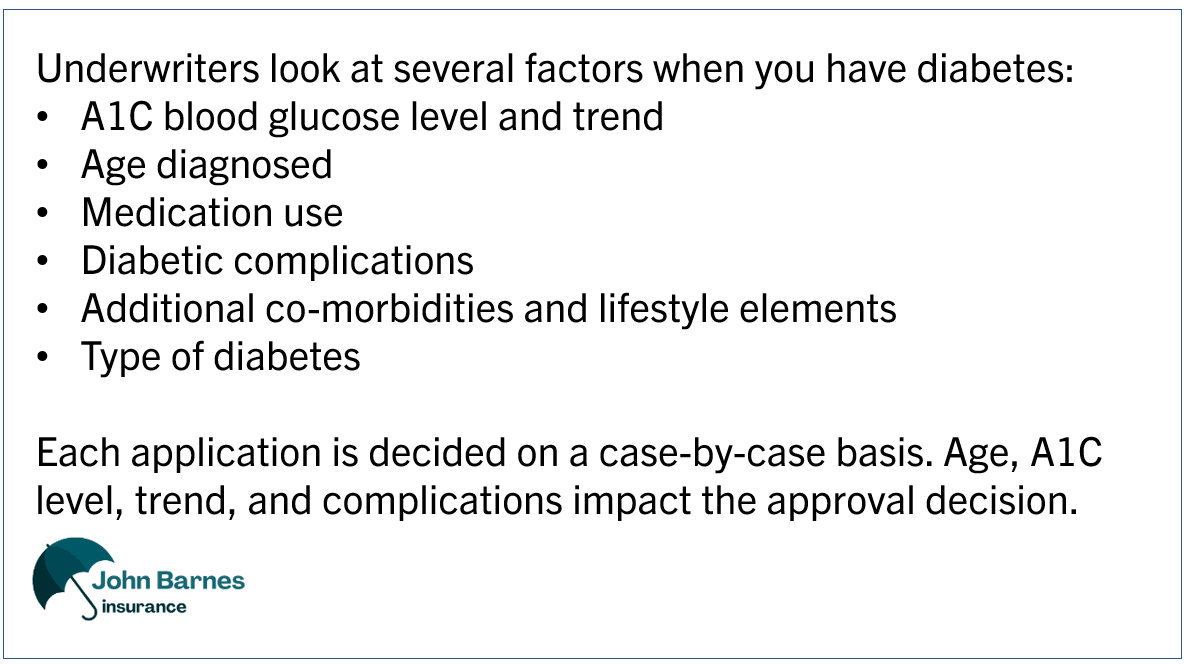
What Life Insurance Underwriters Look At When You Have Diabetes
The underwriting process for a diabetic applicant is slightly more complex than most people expect. Insurers build a risk profile from multiple clinical data points, and understanding them helps you enter the process with realistic expectations.
The A1C blood glucose levels matter, but the trend matters more
The biggest factor during the underwriting process is your A1C level. Most carriers view an A1C under 7.0% favorably, with 6.0% and below optimal. Readings between 7.0% and 8.0% are generally considered moderate risk and remain insurable at most carriers, though premiums will reflect the higher classification. Once A1C climbs above 8.5% to 9.0%, the likelihood of significant table ratings, postponement, or decline increases meaningfully.
The critical underwriting nuance is that a single favorable reading matters less than a stable or improving trend over 12 to 24 months. Underwriters want evidence that the condition is under control as a pattern, not a lucky snapshot. These A1C thresholds reflect standard underwriting practice across most major carriers and are consistent with widely published insurer rate guides.
Medication use and complications
Insulin dependence signals a more complex clinical picture than diet-only or oral medication management, and underwriters treat it accordingly. Beyond medication type, the presence of complications is often more consequential than A1C alone. Neuropathy, retinopathy, nephropathy, and cardiovascular disease can all worsen underwriting outcomes significantly, regardless of blood sugar numbers. An applicant with a 7.2% A1C and no complications is a fundamentally different file from someone with the same A1C and kidney disease. Kidney involvement, notably, is consistently the most serious complication in underwriting and can push an applicant out of traditional underwriting entirely.
What time since diagnosis and age of onset tell an underwriter
Your age when diagnosed matters greatly to underwriters. Carriers will likely decline a life insurance application from a newly diagnosed diabetic. They will want to see 6 to 12 months or more of documented stability before offering their most competitive rates. A long history of stable management, by contrast, is a genuine positive. However, age of onset also factors into mortality projections, particularly for Type 1 diabetics, where an earlier diagnosis means a longer cumulative exposure period that underwriters weigh into their risk calculations. All things being equal, a person diagnosed with type 2 diabetes at age 52 will have a better underwriting outcome than a person diagnosed at age 32. (Note: I am not talking about rates, which will likely be higher for the 52-year-old because he or she is older. It is always better to apply for life insurance now even if rates will be higher.)
The Type of Diabetes Matters
Having type 2 diabetes is more favorable than having type 1 diabetes, all things being equal. The reason is that type 1 can lead to a higher risk of long-term complications and health problems. People with type 1 diabetes are also subject to insulin dependency, requiring lifelong monitoring and medication. Any mistake can be life-threatening.
Lifestyle Elements
Smoking status, weight, exercise habits, and other health conditions such as high blood pressure, heart disease, sleep apnea, etc., stack on top of diabetes in the risk calculation.
The underwriting process isn't about punishing you for having diabetes. It's about proving you're managing it responsibly enough that your life expectancy matches someone without the condition.
Type 1 vs. Type 2: Why Your Diagnosis Type Changes the Life Insurance Options
Many life insurance guides treat all diabetes as a single underwriting category. That mistake leads to misplaced expectations. The distinction between Type 1 and Type 2 diabetes directly affects what offer you're likely to receive and which carriers to focus on.
Why people with type 2 diabetes generally get better life insurance offers
Well-controlled Type 2 diabetes managed through oral medication with no complications can qualify for Standard or even Standard Plus rates at certain carriers. People with type 2 diabetes are generally diagnosed later in life, resulting in a shorter impact of complications due to diabetes. However, this is balanced against other underwriting risk factors such as height/weight, tobacco use, alcohol consumption, and other health conditions.
Can I Get Life Insurance With Diabetes if I Have Type 1?
Yes, absolutely. People with type 1 diabetes typically land in substandard, table-rated underwriting classes, often Table 4 through Table 8, rather than standard rates (i.e., normal health). However, some carriers won't offer coverage for Type 1 at all, while others evaluate the same profile case by case and approve it. Knowing this upfront prevents wasted applications and unnecessary hard inquiries on your medical record. The goal for Type 1 applicants isn't a single universal answer; it's finding the right carrier for your specific clinical profile.
If you have type 1 diabetes, contact us. While we offer underwritten life insurance options for people with type 1 diabetes, we also offer guaranteed issue life insurance with death benefits over $100,000. These plans can be a nice "bridge" until you qualify for something else or better.
The Types of Life Insurance Available for Diabetics
Many types of life insurance policies exist for diabetics. However, not every policy type suits every diabetic applicant. Choosing the right product for your health situation is what keeps premiums manageable and coverage meaningful.
The right life insurance policy and best rate depend on your:
- blood sugar levels and A1c readings
- life insurance needs
- medication
- additional health conditions and chronic conditions
- age at diagnosis
- personal circumstance like lifestyle issues, etc.
Let's discuss the life insurance available for people with diabetes.
Term life insurance: the most affordable option for well-managed cases
Term life insurance is the most cost-effective option for people with diabetes who have solid control, stability, and no major complications. Coverage amounts of $1,000,000 or more are available through full underwriting, and some carriers even offer instant-decision or accelerated underwriting.
If you would like to review life insurance rates, feel free to use the quote tool below. Just enter the face amount and other required information. Note: results are estimates only.
I'm aware of other websites that say you can get preferred rates. While that is possible, carriers are unlikely to offer that health class. As I discussed, that's because of the long-term effects of diabetes. Of course, diagnosis age matters. A person diagnosed with diabetes at age 55 with a very stable situation will likely have a better underwriting outcome than someone who was diagnosed at age 35, all things being equal.
The best possible outcome will be standard, with a few situations eligible for "standard plus" (a health classification between preferred and standard). While table ratings will push premiums above standard rates, the total cost is usually still far lower than alternative policy structures. If your A1C is consistently below 7.0% and you have no documented organ complications, a fully underwritten term policy from a diabetic-friendly carrier is typically the right starting point, and the product most likely to deliver meaningful coverage at a reasonable cost.
Whole life and universal life for well-managed situations
Additionally, permanent life insurance options such as whole life and universal life/IUL are available for well-managed diabetes cases. While term life is the most cost-effective option, permanent life insurance delivers unique planning opportunities through cash value, notably by borrowing for income-tax-free income. This article doesn't cover permanent life insurance strategies. However, they are real options for well-managed situations. Contact us if you would like to learn more.
No-exam and simplified issue: less scrutiny, but real trade-offs
No-exam life insurance for people with diabetes typically caps coverage around $500,000 for term and $50,000 for whole life, with some carriers extending up to $1,000,000 for well-qualified applicants- figures that reflect standard product limits across the simplified-issue market. Most carriers still require health questions, and insurers retain the right to pull medical records, so this isn't a way to avoid disclosure. Premiums run higher than fully underwritten policies because the insurer is pricing in the information gap. This is a reasonable path for applicants who want a faster process or have mild complications that make full underwriting uncomfortable. Still, it costs more per dollar of coverage.
Final Expense Insurance
Final expense insurance is an affordable option for people with diabetes who want coverage for funeral and burial costs. Underwriting is simple: a yes/no health questionnaire, no medical exam or records, with many carriers accepting people with diabetes and even some accepting people with diabetic complications such as neuropathy, retinopathy, and more.
Final expense insurance makes sense for older seniors who want funds to cover their funeral expenses and other end-of-life costs. It isn't appropriate for young adults unless they have other serious comorbidities that make final expense insurance their only option.
If you want to review your final expense options, feel free to use the quoter below. Note: Not all carriers are available on the quoter. Depending on your situation, we may have additional options.
Guaranteed issue life insurance
I have a feeling about what you are thinking.
John, I know about these guaranteed-issue whole life plans offering $25,000 with a 2-year waiting period. I have a family and need more coverage!
While those guaranteed-issue policies exist, I am not talking about them.
I'm talking about the ones that offer $100,000 or more in death benefits. They are through limited partnerships and associations.
They do have a couple of preliminary questions: you need to be working in gainful employment 20+ hours per week, and you can't have any terminal illness or cancer, for example. Most of you will qualify. We offer guaranteed life insurance options totaling $400,000 or more, depending on your age and state of residence. These plans let you have coverage while you work toward something better.
Contact us if you would like to learn more or have any questions
What Diabetics Actually Pay Compared to Standard Life Insurance Rates
People with diabetes may pay higher life insurance rates than those without the disease. The reason, as I mentioned, is due to the possible long-term complications diabetes has on the body. Actuarial data supports this. People diagnosed with diabetes earlier in life will likely pay higher premiums than someone who isn't, all things being equal.
One main point I want to drive home: you will get the best life insurance rates you can, given your situation. I've helped many people with diabetes obtain life insurance. Some had unrealistic expectations about premiums, reading elsewhere that they should get preferred or standard rates because some other website said so. Turning down approved applications to seek better rates creates a downward spiral, and these people lost focus on what really matters: getting life insurance to protect their loved ones and family. That is why you are reading this article, right?
Establishing realistic premium benchmarks prevents sticker shock and helps you evaluate whether the offers you receive are competitive or if you should shop further. You are in the right place; we can help you find the lowest-cost life insurance for your situation.
Let's reiterate 2 main underwriting factors that drive potential premiums for people with diabetes.
How A1c control level drives the premium loading
Well-controlled Type 2 diabetics with no complications typically pay 10% to 50% more than comparable non-diabetic standard rates. Moderate control pushes that loading to 30% to 75%. Type 1 diabetics, even with excellent control, often see 50% to 150% increases over standard rates. Poor control or significant complications can double or triple premiums beyond that or even lead to a declined application. Each table rating adds roughly 25% above standard, a common industry benchmark, though increments vary by carrier; a Table 4 rating represents about 100% above the base standard rate. Understanding table ratings as a pricing mechanism rather than a judgment helps applicants compare offers across carriers on an apples-to-apples basis.
How age increases the cost gap for diabetics
Your age of onset matters. So does when you apply. If you apply between ages 30 and 40 with well-controlled Type 2, the premium difference versus a non-diabetic might be 20% to 50%. By ages 50 to 60, that gap frequently widens to 25% to 75% even with the same level of control, because the underlying base rate is already higher and the diabetic loading compounds on top of it. This dynamic creates a practical incentive to apply earlier rather than wait, especially for Type 1 applicants or anyone with documented complications. The math of waiting rarely works in a diabetic applicant's favor.
Practical Steps to Strengthen Your Application Before You Apply
Several controllable factors directly influence which underwriting class you land in and the premiums you'll pay. Addressing them before you apply can lower your premiums.
Getting your numbers in shape before you apply
An A1C improvement before an application can move you from one underwriting class to a meaningfully better one. Because underwriters weigh the trend, not just the most recent reading, working with your physician to stabilize readings over at least 6 months before applying is time well spent. Managing your weight, maintaining a healthy diet, staying physically active, taking your medications consistently, limiting alcohol, and resolving any open health issues are all factors underwriters review, and each can nudge your classification in a favorable direction. A stable, improving trend across two or three lab results is far more persuasive than a single good number after a period of poor control.
Of course, your actual A1C level still matters. An A1C of 6.0% offers a better underwriting outcome than 8.2%, even if 8.2% is your lowest in the last 6 months.
Documents to gather and what to disclose honestly
Before you apply, gather recent lab results, including your A1C, kidney function panels, and cholesterol readings. Have a complete and current medication list ready, along with your physician's contact information and the dates of your diabetes diagnosis and any significant health events. Full, accurate disclosure isn't just an ethical obligation. It's a practical protection. Underwriters will pull medical records, and inconsistencies between your application and your clinical history hurt far more than honest disclosure does. A claim denied for misrepresentation is far worse than a table-rated policy with honest terms.
Why the Carrier You Apply to Changes Everything
For diabetic applicants, carrier selection is the single most consequential variable in the entire process. This is where applications succeed or fail, and where the right broker can make a measurable difference.
Carrier underwriting guidelines vary more than most people realize
While many life insurance carriers will insure people with diabetes, they all maintain different A1C tolerances, different views on insulin dependence, and different table-rating schedules for diabetic applicants. One carrier may decline a Type 1 applicant outright while another evaluates the identical profile on a case-by-case basis and returns an approval at Table 4. That difference can mean the gap between no coverage at all and a functional policy with a reasonable premium. No universal answer exists for what a diabetic applicant will be offered across the market, which is exactly why applying to the wrong carrier first is a costly mistake.
How an experienced, independent broker with access to multiple carriers changes the outcome
An independent broker works with many carriers and can speak to underwriters about your situation on your behalf. That way, you already have a good idea of who will take an application and who won't before you apply. Additionally, you'll receive an estimated rate. Your broker can "shop" your situation, find the right carrier, and move forward with an application accordingly.
On the other hand, a captive agent represents one company. If that company's underwriting guidelines don't match your diabetes profile, the answer is no, and the conversation ends there. Moreover, you now have a decline on your MIB report. (This isn't a big deal as long as you don't keep applying to the wrong carriers.)
It bears repeating: an independent broker who understands which carriers maintain favorable diabetic underwriting at different A1C levels, complication profiles, and insulin-dependence situations can match your file to the carrier most likely to offer the best terms. For people with type 1 diabetes and anyone with complications, that carrier-matching process is the single biggest variable in what offer you receive.
As an experienced broker who has helped many people with diabetes obtain life insurance, I work with dozens of carriers and evaluate diabetic applications against those specific guidelines before a single application goes out, which is why clients declined elsewhere often receive approvals or meaningfully better rates.
Frequently Asked Questions About Life Insurance and Diabetes
Can I get life insurance if I have diabetes?
Yes, people with diabetes can absolutely get life insurance. Insurance companies have refined underwriting to focus on how well you manage your diabetes, not just the diagnosis itself. Well-controlled diabetics with A1C levels under 7.0 and no complications often qualify for standard or low table ratings on traditional policies.
What A1C level do I need to get approved for life insurance?
An A1C under 7.0 typically opens the door to approval with most carriers. An A1C under 6.5 often qualifies you for better rates, meaning lower premiums. Above 8.0, you'll likely face rated policies with higher premiums or possible declines, though some carriers specialize in higher-risk cases.
Do insurance companies treat Type 1 and Type 2 diabetes differently?
Some carriers simply decline applications from people with type 1 diabetes, while others will approve. Same with type 2. Insurance underwriters care more about diabetes control than whether you have Type 1 or Type 2. A person with type 1 diabetes with excellent glucose control, no complications, and consistent monitoring will receive better rates than a Type 2 diabetic with poor management. Your health metrics matter more than your diagnosis classification, but choosing the right company matters too.
What do life insurance underwriters check when I have diabetes?
Underwriters review your A1C levels, time since diagnosis, complications like retinopathy or neuropathy, medication compliance through pharmacy records, and daily habits, including weight, smoking status, and exercise. They're looking for evidence that you're managing your condition responsibly.
Should I wait to apply for life insurance until my A1C improves?
If your current A1C is 7.5 or higher, waiting until it's below 7.0 can greatly improve your rates and approval odds. Even a small improvement from 7.8 to 6.9 can shift you into a better rating class and save hundreds or thousands in premiums over the policy's life.
What happens if I get declined for life insurance because of my diabetes?
A decline isn't permanent. Request the specific reasons in writing; the insurer must provide them. This tells you exactly what to improve before reapplying. Contact an experienced, independent broker for help. He or she can consult with underwriters on your behalf to see what options you have.
Are there life insurance policies specifically for people with diabetes?
Yes, some insurance companies offer specialized underwriting programs for people with diabetes that focus heavily on management metrics rather than the diagnosis itself. These programs commonly approve applicants whom traditional underwriting would decline. Additionally, simplified issue and guaranteed issue policies provide alternatives when medical underwriting is too strict.
Do I need a medical exam to get life insurance as a person with diabetes?
For underwritten traditional term and whole life policies, likely yes. They require a medical exam, which includes blood work that checks your glucose levels. Most carriers want an updated A1C from their testing. However, simplified issue policies skip the exam and ask only health questions, while guaranteed issue policies require neither an exam nor health questions.
Can I get life insurance through my employer if I have diabetes?
Group life insurance through employers typically doesn't require medical underwriting, meaning people with diabetes get the same rates as non-diabetics. This is often the easiest coverage to obtain, but the downside is that it usually ends when you leave the company, and coverage amounts may be limited.
What mistakes should I avoid when applying for life insurance as a person with diabetes?
Never downplay your condition or leave out details you consider irrelevant. Underwriters cross-reference applications with medical records and prescription databases, and inconsistencies can lead to automatic declines. Also, avoid applying to the wrong carrier first, because rejections stay on your record, and don't rush your medical exam prep.
Underwriters prioritize diabetes management over diagnosis type. A well-controlled Type 1 diabetic with an A1C under 6.5 and no complications will receive better rates than a poorly managed Type 2 diabetic, proving that control matters more than classification.
Can I get life insurance if I have gestational diabetes?
Yes, you can get life insurance if you had gestational diabetes. Gestational diabetes isn't underwritten the same way as type 1 or type 2 diabetes. If you apply for life insurance while pregnant with gestational diabetes or in the first few months postpartum, most carriers will postpone a decision until you have updated A1C and fasting glucose results. As with traditional diabetes, you will want to show that your A1C has returned to a normal level.
Key Takeaways
Your A1C level is the single most important approval factor. Keeping your A1C under 7.0 opens approval doors; under 6.5 qualifies you for preferred rates; and anything above 8.0 typically results in rated policies or declines.
Preparing in the 12 months before you apply can save thousands in premiums. Improving your A1C, getting clean complication screenings, and organizing your medical records before submission can greatly improve your rating class and approval odds.
Not all insurance companies treat diabetic applicants equally. Working with an independent broker who knows which carriers favor your specific diabetes profile helps prevent wasted applications and rejections that can stay on your permanent record.
Alternative policy types exist when traditional underwriting doesn't work. Simplified issue, guaranteed issue, group life through employers, and diabetic-specific programs offer coverage options when full medical underwriting results in high ratings or declines.
Application honesty and accuracy are non-negotiable. Underwriters cross-reference applications with medical records and prescription databases, and any contradictions can lead to automatic declines, regardless of how well-controlled your diabetes is.
A decline or high rating isn't permanent. If you improve your health metrics, obtain updated medical documentation, or apply to a different carrier with more favorable underwriting standards, your approval outcome can change completely.
The Bottom Line: Can I Get Life Insurance With Diabetes?
For most people, the answer is yes. Life insurance with diabetes is attainable, and the outcome depends far more on preparation and carrier selection than on the diagnosis itself. A well-controlled diabetic with no complications who applies through the right carrier is in a genuinely strong position. Even applicants with Type 1 diabetes or mild complications have real options, including insulin-dependent life insurance products from carriers that underwrite those cases individually, and guaranteed issue coverage exists as a backstop for the most complex situations.
The first concrete step is simple: gather your recent lab results, put together an honest account of your current medications and health history, and connect with someone (i.e., me) who can shop the full market on your behalf. Each step matters because underwriters weigh the full picture, and a cleaner file translates directly into a better underwriting class and lower premiums. Applying to the wrong carrier wastes time, generates unnecessary inquiries, and risks a decline that could have been an approval elsewhere.
If you've been asking yourself, "Can I get life insurance with diabetes?" the answer starts with understanding your specific clinical profile and which carriers match it. Ready to find out what life insurance options you have? Contact me or use the link below. We'll start with your current health picture, no application required, no commitment, just a clear read on your options and which carriers are most likely to offer the coverage you need. As always, I work in your best interest. There is no risk to speaking with me. If I can't help, I'll point you in the right direction. You can always contact me again if your situation changes.