
Getting Approved for Life Insurance with Rheumatoid Arthritis
Tips for Life Insurance Approval, Better Rates, and Coverage with Rheumatoid Arthritis. Everything You Need to Know About Life Insurance Eligibility with RA. How Insurers Evaluate Rheumatoid Arthritis When Reviewing Applications

Getting denied for life insurance because of rheumatoid arthritis feels like a kick when you're already down.
You're trying to protect your family, but the insurance world treats your condition like you're uninsurable. The truth is, thousands of people with RA get approved every year. They just know what underwriters are actually looking for.
Most agents won't walk you through the nuances. They'll rush your application, miss key details about your treatment history, and you'll end up with a rejection letter or high premiums.
It doesn't have to be this way. In this guide, here's exactly how to position your application so that underwriters see you as an acceptable risk, not a red flag, and can obtain the best possible rate.
What Life Insurance Underwriters Actually Evaluate When You Have Rheumatoid Arthritis
We start with a discussion of underwriting because it is the foundation of an application's approval or decline.
Insurance companies don't just see "rheumatoid arthritis" and stamp your file as rejected.
They're running a risk calculation based on specific markers that predict your long-term health outcomes. They are going to review the severity of your condition. Understanding what they're measuring gives you the power to shape your application around their criteria. Most people with RA get declined or rated up because they don't know these evaluation points exist.
When it comes to rheumatoid arthritis, here's what underwriters dig into:
- Disease activity score: They want to see low inflammation markers like CRP and ESR levels. If your rheumatologist has documented remission or low disease activity for six months or longer, that's gold in underwriting language.
- Medication stability: Being on the same effective treatment for over a year shows control. Frequent medication changes signal instability and raise red flags.
- Functional capacity: Can you work full time? Do daily activities without assistance? Joint damage is less concerning if you're fully functional.
- Comorbidities: Heart disease, lung involvement, or kidney issues tied to RA dramatically change your risk class. Clean reports from your rheumatologist about organ function matter.
- Age at diagnosis: Being diagnosed later in life (after 40) usually results in better underwriting outcomes than juvenile-onset RA.
- Frequency of flare-ups: the fewer flare-ups, the better chance you have of an underwritten life insurance policy
- Body parts affected: Joint pain, joint inflammation and damage from RA, and the inability to use a particular body part because of RA can all increase your mortality risk
Your application isn't just a yes-or-no. Underwriters assign you a risk class (Preferred Plus, Preferred, Standard Plus, Standard, or Table Rated). Knowing these evaluation criteria lets you gather the right medical records before you even apply.
Does My Rheumatoid Arthritis Medication Matter In Life Insurance Underwriting?
Yes, it does. Rheumatoid arthritis can be treated with varying types of medication, all of which have side effects, but all of which are treated differently by underwriters. The type of medication you take indicates the severity of your RA. Some medications signal mild disease with minimal impact on life expectancy. Others suggest aggressive autoimmune activity that requires careful monitoring. Understanding how each drug class is perceived helps you anticipate how your application will be evaluated.
The types of medication include:
- NSAIDs (Non-steroidal Anti-Inflammatory Drugs) - These include ibuprofen, naproxen, and celecoxib. Underwriters view these as symptomatic relief rather than disease-modifying treatment. If NSAIDs are your only medication, it may suggest mild RA or early-stage disease, which can result in better ratings. However, long-term NSAID use raises concerns about cardiovascular risk and kidney function.
- DMARDs (Disease-Modifying Antirheumatic Drugs) - Methotrexate, sulfasalazine, and hydroxychloroquine fall into this category. These are frontline treatments for RA and signal that your rheumatologist is managing the disease proactively. Stable use of a single DMARD with good lab results (liver enzymes, kidney function, blood counts) is viewed favorably. It shows your disease is controlled without needing biologics.
- Biologics and Targeted Therapies - Drugs like Humira, Enbrel, Remicade, Orencia, and Xeljanz indicate moderate to severe RA. These are powerful immunosuppressants that target specific inflammatory pathways. While they suggest a more serious situation, they also show you're under specialist care and responding to advanced treatment. Underwriters will closely review infection history, cancer screening, and cardiovascular health when biologics are involved.
- Corticosteroids - Prednisone and similar steroids are often used short-term for flare management or as bridging therapy. Long-term corticosteroid use is a red flag. It suggests poorly controlled disease and increases risk for osteoporosis, diabetes, hypertension, and infections, all of which negatively impact life insurance ratings.
Timing Your Application for Maximum Approval Odds
Applying at the wrong time tanks your chances before the underwriter even opens your file.
If you apply during a flare-up, while switching medications, or right after a new diagnosis, you're volunteering to get declined. Underwriters need to see stability. That means documented evidence that your RA is controlled and your treatment is working. Rushing the application costs you thousands in premiums or results in rejection.
Wait until these conditions are met:
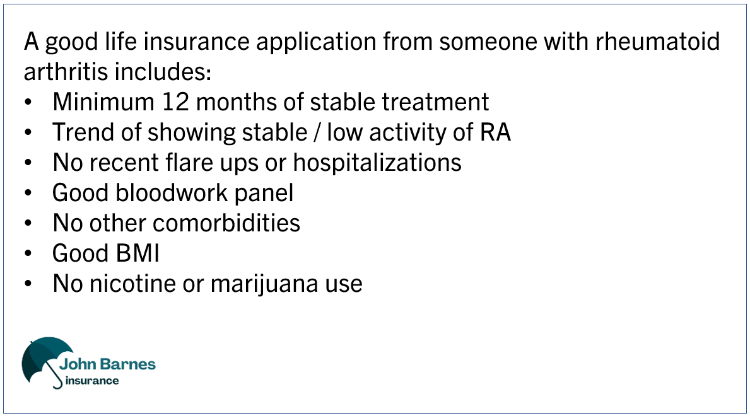
- At least 6 to 12 months on stable medication with documented effectiveness. If you just started a biologic, immunosuppressive drugs, or changed DMARDs, wait until your rheumatologist confirms it's working.
- Two consecutive appointments showing low disease activity. Underwriters love seeing a pattern, not a one-time good report.
- No current flare-ups or recent hospitalizations. If you were hospitalized or had a severe flare in the past three months, delay your application.
- Clean bloodwork showing controlled inflammation markers. Get copies of your CRP, ESR, and rheumatoid factor levels. If they're elevated, work with your doctor to get them down before applying.
One more thing: if you were recently denied by another carrier, wait at least six months before reapplying. Multiple denials on your record make every future application harder. Use that time to improve your medical documentation and stability markers.
Other Important Underwriting Factors
Underwriters consider other aspects of your situation to determine whether you are an acceptable risk. Here are the other important components of the life insurance underwriting process:
- Your height, weight, and BMI
- Other health conditions, medical conditions, and medical history - any moderate to severe comorbidities could negatively affect the application decision
- Nicotine and marijuana use
- Driving record and hazardous activities
- Bankruptcy history
- Substance Abuse history
Underwriters will request your medical records from your rheumatologist to confirm your RA stability. They also may request a paramedical exam where an examiner comes to your office or residence (or you can go to a lab if you live near one) to take your height/weight, blood pressure, a urine sample, and a blood sample. It's like a mini-physical exam. Although many carriers are moving away from the paramedical exam, the life insurance company may request one.
Why Table Ratings?
I am aware that many other websites say that people with mild rheumatoid arthritis may qualify for standard rates. I want to be honest here that that may not be true. While it may be possible for a carrier to offer standard rates to a person with very, very mild rheumatoid arthritis, the carrier will likely offer a policy with a table rating.
What is a table rating? It is an increase in premium to offset an increase in risk, in this case, the risk of dying too soon.
But John, aside from the RA, I am completely healthy!
I understand that. However, rheumatoid arthritis can reduce a person's life expectancy. Various studies have shown a life expectancy reduction of 5, 10, and even 12 years or more versus someone without RA.
The reduced life expectancy isn't directly due to the RA itself, but rather the disease presents other risk factors and side effects, such as cardiovascular disease, organ damage, respiratory issues, and a host of other problems.
Underwriters know this, which is why they will offer a policy with a table rating.
In our experience, if you have mild rheumatoid arthritis, are gainfully employed, and the disease has no effect on your everyday life, expect a table rating between 2 and 4. If you have moderate RA, expect a table rating between 6 and 8 or higher. People with severe rheumatoid arthritis can likely expect a decline with traditional underwritten life insurance. (However, see our guaranteed issue options below.)
| Severity of RA | Table Rating | Types of Life Insurance Available |
|---|---|---|
| Mild | T2 - T4 | Any (Term, Permanent, etc.) |
| Moderate | T6 - T8 | Any, but guaranteed issue an option |
| Severe | T8 to decline | Term might be tough; guaranteed issue likely best case |
Choosing the Right Insurance Company and Product
Not all life insurance companies underwrite rheumatoid arthritis the same way.
Some carriers have strict autoimmune disease guidelines and will automatically table rate you or decline your application. Others specialize in high-risk cases and have underwriting teams experienced with RA. Applying to the wrong company wastes time and creates a denial on your record that follows you. This is where working with an independent agent who knows carrier strengths becomes invaluable.
Carrier types that work best for RA applicants:
- Carriers with lenient autoimmune guidelines: Many top-rated life insurance companies have historically been more flexible with well-controlled RA cases. They traditionally have had a deep understanding of RA. Your broker should be able to provide rate estimates from these companies.
- No-exam policies for mild cases: Simplified issue or accelerated underwriting products skip the medical exam and rely on health questions plus prescription data. If your RA is mild and well-managed, these can fast-track approvals.
- Guaranteed issue as a last resort: If you've been declined everywhere else, guaranteed issue whole life policies accept anyone, but come with lower coverage amounts and higher premiums. It's expensive, but it's coverage. People with severe cases of rheumatoid arthritis (i.e., disabled, not working) are eligible for guaranteed issue plans.
- Bridge Life Insurance options: these are simplified issue life insurance products with 1 or 2 health questions on the application. The main underwriting factor is that you are gainfully employed and work more than 20 hours per week. These are both term and whole life products and can be good options if you need sme coverage while you wait to qualify for better life insurance coverage.
Life Insurance Options for People with Rheumatoid Arthritis
The right life insurance option is the one that intersects with your situation. No matter your situation, however, we can get you life insurance.
Here is a breakdown of the types of life insurance available for people with rheumatoid arthritis.
Mild rheumatoid arthritis - fully underwritten term life insurance is available, as well as other types such as universal life and whole life. As mentioned, expect a light table rating. If you have an early diagnosis of RA and work full-time, then the bridge life insurance options (discussed below) are available as well. Please note: if you are on SSDI, nearly all carriers will decline your term life insurance application.
Moderate rheumatoid arthritis - fully underwritten term and whole life are available, but expect a higher table rating. In your case, applying for some of the bridge life insurance options may make sense
Severe rheumatoid arthritis - this is where your condition is so severe that it negatively impacts your quality of life. Maybe you are on SSDI or not working because of your RA. A simplified issue or guaranteed issue whole life plan may be your best option.
Were you just diagnosed, or do you not want to go through underwriting? We have "bridge" life insurance options available.
Bridge Life Insurance Options for People with Rheumatoid Arthritis
These are simplified issue or guaranteed issue life insurance plans with higher death benefits, such as $100,000. As I mentioned, these are good plans if you were just diagnosed and need some coverage while you establish treatment stability. Or, you just don't want to go through the life insurance application process. Current options, subject to change at any time, include (subject to state availability):
- $50,000 term to age 80
- $75,000 term to age 75
- $100,000 term to age 121
- $150,000 term to age 70 (or 10-yr, 20-yr terms)
- $100,000 whole life insurance
- $80,000 whole life insurance
Wow! This is a short sampling that totals over $500,000. So, you can get over $500,000 of life insurance at guaranteed issue or simplified issue (1-2 health questions, which you would qualify for as long as you only have RA) and you are gainfully employed 20+ hours per week.
Contact us if you would like to learn more. These bridge life insurance options are ideal for people who:
- were just diagnosed with RA
- have additional co-morbidities, but still work in gainful employment
- are comfortable with death benefits up to approximately $500,000
- don't want to go through underwriting or paramedical exams, blood tests, urine samples, etc.
Documents and Records That Strengthen Your Life Insurance Case
Underwriters make decisions based on paperwork, not your word. They rely heavily on medical records, especially with autoimmune conditions such as rheumatoid arthritis.
If your medical records are incomplete, vague, or missing key details about your RA management, the underwriter fills in the blanks with worst-case assumptions. That means higher premiums or outright denial. Take control by providing comprehensive, organized documentation that shows stability and effective disease management.
Gather or review these records before applying:
- Rheumatologist visit notes from the past 12 to 36 months showing your treatment plan, disease activity scores, and functional assessments. As noted, underwriters are looking for stability.
- Lab results including CRP, ESR, rheumatoid factor, and anti-CCP antibodies. Highlight any results showing normal or low inflammation.
- Medication list with dosages and start dates. Include how long you've been on your current regimen without changes.
- Imaging reports (X-rays, MRIs, ultrasounds) that document joint condition. If there's no progression of damage, that's a positive signal.
- Letters or records from your rheumatologist stating that you're in remission or have low disease activity, are fully functional, and are compliant with treatment. A well-worded letter can sway an underwriter on the fence.
Organize everything chronologically and highlight the positives. If your doctor's notes mention a flare from two years ago but you've been stable since, include a brief cover letter highlighting your current stability. Underwriters process dozens of files a day. Making their job easier increases your chances of approval.
Frequently Asked Questions About Life Insurance and Rheumatoid Arthritis
We discuss and answer questions about life insurance and rheumatoid arthritis.
Can you get life insurance with rheumatoid arthritis?
Yes, most people with rheumatoid arthritis can get life insurance.
Approval depends on disease severity, treatment stability, medications used, and the presence of complications such as joint damage or organ involvement.
Is rheumatoid arthritis considered a pre‑existing condition for life insurance?
Yes, rheumatoid arthritis is considered a pre‑existing condition.
Life insurance companies review pre‑existing conditions during underwriting to assess long‑term risk, but RA alone does not automatically disqualify an applicant.
How do life insurance companies evaluate rheumatoid arthritis?
Life insurers typically evaluate:
- Severity and progression of RA
- Age at diagnosis
- Frequency of flare‑ups
- Medications (biologics, DMARDs, steroids)
- Joint damage or mobility limitations
- Overall health
- Related conditions, such as heart or lung involvement
What life insurance rating can someone with rheumatoid arthritis receive?
Applicants with well‑controlled RA will qualify for low table‑rated policies.
Mild RA with a stable treatment history can receive favorable ratings, while advanced RA may be assessed at higher rating classes.
Do biologic medications affect life insurance approval?
Yes, but biologic medications often help rather than hurt.
Biologics and DMARDs typically indicate proactive disease management, which insurers view more favorably than untreated or poorly controlled RA.
Can rheumatoid arthritis cause a life insurance denial?
Rheumatoid arthritis alone rarely causes a denial.
Denials usually occur only when RA is severe and accompanied by major complications, frequent hospitalizations, or significant secondary health conditions.
Is term life insurance easier to get with rheumatoid arthritis?
Yes, term life insurance is usually the easiest option for people with RA.
Term policies offer flexible underwriting and are commonly approved for applicants with stable or moderate rheumatoid arthritis.
Can you get no-medical-exam life insurance with rheumatoid arthritis?
Yes, no‑exam life insurance options are available.
These policies rely on health questionnaires rather than exams, but often have higher premiums or lower coverage limits for people with RA.
Please review our options in our "bridge" life insurance section for examples.
Does rheumatoid arthritis affect life expectancy for life insurance?
Modern treatments have greatly reduced RA’s impact on life expectancy; however, many studies still indicate RA can reduce life expectancy.
Many insurers now account for advances in biologic therapies and early treatment, especially when the condition is well managed.
What makes rheumatoid arthritis more favorable to insurers?
Rheumatoid arthritis is viewed more favorably when:
- Symptoms are mild or moderate
- Treatment has been stable over time
- Flare‑ups are infrequent
- Steroid use is limited or well-controlled
- There is little or no organ involvement
Does age at diagnosis matter for life insurance?
Yes, earlier diagnosis with stable management is generally viewed more positively and is eligible for favorable rates.
Applicants diagnosed later in life or with long‑term progression may face stricter underwriting.
Should someone with rheumatoid arthritis use an insurance broker?
Yes, an independent broker who specializes in helping people with rheumatoid arthritis can significantly improve outcomes.
Brokers understand which insurers are more favorable toward RA and can shop applications strategically.
How can someone with rheumatoid arthritis improve life insurance approval chances?
To improve approval and rates:
- Follow prescribed treatment plans
- Maintain consistent rheumatology care
- Control related health conditions
- Apply before the RA progresses (i.e., apply in the early stages of the condition)
- Work with an experienced life insurance professional
What information will life insurers request for rheumatoid arthritis?
Life insurance underwriters may request:
- Diagnosis date and severity
- Medication history
- Physician or rheumatologist reports
- Lab results or medical exams (if required)
- Anything else the underwriter deems material to making a decision
Is it better to apply for life insurance early with rheumatoid arthritis?
Yes, applying earlier often leads to better rates and more options.
Life insurance is generally more favorable before RA advances or complications develop.
However, you will want to establish treatment history and stability first. Our "bridge" life insurance options allow you to obtain some coverage while you do that.
Final Thoughts About Life Insurance for People with Rheumatoid Arthritis
Living with rheumatoid arthritis doesn't disqualify you from life insurance, but it does mean you need to approach the application strategically. Underwriters are looking for proof that your condition is managed, stable, and not accelerating toward complications. When you apply at the right time, with the right documentation, through the right carrier, approval becomes a matter of process rather than luck.
The difference between a decline and an approval often comes down to six months or more of medical records showing stability. Take the time to build that case before you submit anything.
The type of medication also matters, as it indicates the severity of your RA.
No matter your situation, however, I am confident we can get you some level of life insurance. Are you ready to learn more? Contact us. We only work in your best interests. There is no risk to contacting us. I am confident we can help you obtain life insurance.